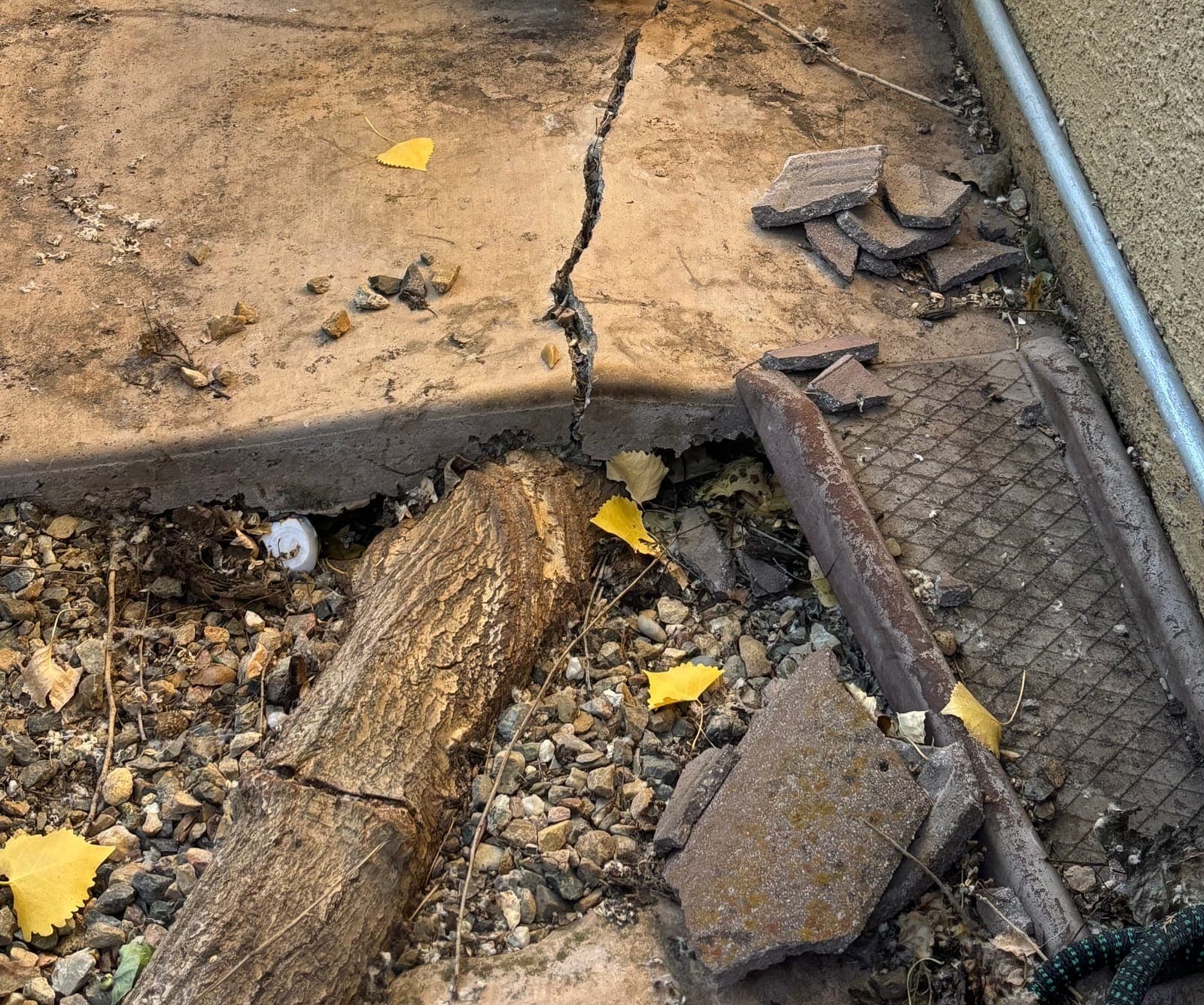
When a tree root lifts a slab, cracks a driveway, or pushes against a foundation, the instinct is to grab a saw and cut the root out. That instinct can be an expensive mistake. A large root like the one in this photo is often a structural root, one of the few that hold the tree up and carry its water, and cutting it in the wrong place can leave the tree unstable, invite decay, or kill it outright, turning a cracked slab into a failed tree over your roof. I am Christopher Hodge, an ISA Board Certified Master Arborist, and this page explains what tree roots do to property, and why the first step is not cutting the root but identifying the tree it belongs to.
What tree roots do to foundations and hardscape
Tree roots grow where the water, the air, and the loose soil are, and that is often right along the edge of a slab, a footing, or a foundation. As a root grows in diameter it acts like a slow wedge. It can lift and crack concrete flatwork, patios, driveways, and sidewalks, heave pavers, and push against foundation walls and footings. Roots rarely break through a sound, deep foundation on their own, but they can widen cracks that are already there, disturb shallow footings, and, on the expansive clay soils common in our foothills, worsen the soil movement that damages foundations. They also find their way into cracked or leaking sewer and drain lines, which is the root intrusion that plumbers deal with.
Before you cut a large root, identify the tree
This is the step almost everyone skips. Before any large root is cut, you need to know which tree it comes from and what that tree can tolerate. Trace the root back to its trunk. A root's size, its position, and its distance from the trunk tell you whether it is a structural root the tree depends on for stability or a minor one that can be pruned safely. Species matters just as much. A deep rooted oak responds very differently from a shallow, aggressive poplar, cottonwood, willow, or elm, the kinds of trees most often behind a lifted slab. Cutting a major structural root close to the trunk can remove a large share of the tree's anchorage and its water supply, and the tree may fail in the next windstorm or decline over the following seasons. The right question is not only how do I stop the damage, but what will this cut do to the tree.
In this region the tree is often a valley oak, blue oak, interior live oak, or California black oak, and on foothill lots a ponderosa pine, gray pine, or incense cedar. It matters because tolerance for root loss is not the same across those species, and because any of those native oaks may be protected by ordinance in El Dorado County, which turns a landscaping decision into a permit question.
Root pruning done right, or removal when it is the only option
Once the tree and the offending root are identified, there are usually options short of losing the tree. Proper root pruning cuts the root cleanly, at a distance from the trunk that the species and the tree's condition can tolerate, often followed by a root barrier that redirects future growth away from the structure. Sometimes repairing the hardscape with more root room, a root deflector, or a slightly relocated path solves the problem without touching a major root at all. But sometimes the honest answer is that the tree is too close, too large, or too dependent on the very roots doing the damage, and removal is the only mitigation that actually protects the structure. Because I run no removal crews, I have no reason to push you toward a removal you do not need, or away from one you do.
Root barriers: a stopgap, not a cure
A tree root barrier deserves its own honest paragraph, because root barriers for trees are sold with more confidence than they have earned. A barrier is a vertical sheet of plastic or composite set in a trench between the tree and the thing being protected, and its real job is to slow root development under infrastructure and redirect new growth deeper, buying years for a slab, a walkway, or a sewer line. That is a legitimate job. What a barrier is not is a forever cure: roots grow over the top when soil or mulch builds up, under the bottom in loose or watered ground, and around any gap at the ends, and a vigorous tree will eventually test all three routes. Treat a barrier as a delay measure that pairs with a proper root pruning cut and a realistic look at the tree, the species, and the distance involved.
Installation is most of whether one works at all. The barrier goes in at the time of root pruning, in a clean trench, deep enough for the soil and species in question, with the top proud of grade so roots cannot silently climb over, and with the ends run well past the zone of conflict rather than stopping at its edges. Shallow, short, or buried flush installations are the ones that fail in two seasons and give the whole tool its mixed reputation. Where a client is weighing a barrier, my assessment covers whether the species and cut can tolerate the root pruning, whether the geometry gives a barrier a fighting chance, and what the honest interval before the next conflict is likely to be, in writing, so the decision is made on the tree's actual timeline rather than a product brochure's.
How I assess root and property conflicts
I come to the site, trace the roots back to the tree, identify the species, and assess the tree's health and structure along with the damage to the slab, footing, or foundation. Then I give you a written assessment with the realistic options: what can be root pruned and how far from the trunk, whether a root barrier or a hardscape change will hold, and whether removal is warranted. If the damage involves the house foundation itself, I will tell you when a structural engineer should also weigh in. You get a clear, independent recommendation you can act on or hand to a contractor.
Root pruning assessment, from $500 with a report
Weigh that against the alternative. Removing the tree commonly runs $1,500 to $4,000 for a medium sized specimen near a house, and it does not by itself repair the slab or the hardscape you were worried about. A root can often be cut at a safe distance, or a barrier installed, and the tree kept. Finding out which applies costs a fraction of the removal and is the step that should come first.
If a tree root is threatening your foundation, a slab, or your hardscape, start with a root pruning assessment before anyone makes a cut. I come to the site, trace the root back to its tree, identify the species, and work out whether the root can be pruned safely, at what distance from the trunk, and whether a root barrier will keep it from returning, or whether removal is the sounder choice. You get a written plan you can act on yourself or hand to a tree crew, so the pruning protects both the tree and the structure. If the root pruning is work I can do with an air spade, the report says so, and that work is quoted separately before it is scheduled. A site assessment with a written report starts at $500. The site visit on its own is $250 for up to one hour on site. Call or text (530) 391-6100 to schedule.
Frequently Asked Questions
Can tree roots damage a house foundation?
They can, though usually indirectly. Roots seldom punch through a sound, deep foundation, but they can widen cracks that already exist, disturb shallow footings and slabs, and, in expansive clay soils, worsen the shrinking and swelling that cracks foundations. Far more often, roots damage the flatwork around a house, the driveways, patios, walkways, and slabs, by lifting and cracking them as they grow.
Can I just cut the root that is lifting my concrete?
Not without knowing what you are cutting. A large root can be a structural root that anchors the tree, and cutting it close to the trunk can make the tree unstable or kill it. Trace the root back to the tree first. An arborist can tell you whether that specific root can be pruned safely, how far from the trunk the cut should be, and whether a root barrier will keep it from returning, or whether removal is the safer answer.
Which trees most often damage concrete and foundations?
Fast growing, shallow rooted, water loving species are the usual offenders: poplars and cottonwoods, willows, silver maple, and some elms. Oaks and other deep rooted trees can still lift hardscape when they are planted too close, but they are less aggressive about it. Identifying the species is part of deciding what can be done, because each one tolerates root pruning differently.
Do you remove the tree, or fix the roots?
I do not remove trees, but I can do the root pruning myself with an air spade. I diagnose the conflict and write the recommendation, whether that is root pruning at a safe distance, a root barrier, a hardscape change, or removal. Where the answer is root work I can do, the report says so, and you are free to hire anyone you like to carry it out. The advice rests on the tree and the structure, not on selling you a removal. Call or text (530) 391-6100.
What does root barrier installation involve?
A trench between the tree and the structure, cut at the time the offending roots are pruned, with the barrier set deep for the soil and species, its top left slightly above grade so roots cannot climb over unseen, and its ends extended well beyond the conflict zone. Done that way it slows root development under the infrastructure for years. Done shallow and short, it is overgrown in a couple of seasons. Either way it is a delay measure, and the assessment's job is to say honestly how long a delay to expect.
Can tree roots damage a foundation?
Yes, though usually not the way people picture it. Roots rarely break through a sound foundation directly. The common damage is indirect: on shrink swell clay soils, roots dry the soil under a footing and the ground settles unevenly, and under slabs, driveways, and walkways, enlarging roots lift and crack the hardscape from below, which is most of what I am called to look at. That distinction matters because the fix differs: hardscape conflicts have root side options, while genuine foundation movement needs the soil and drainage read alongside the tree.
Will a root barrier stop tree roots from coming back?
A root barrier can help, but it is not a cure on its own. Installed correctly, a barrier redirects new root growth down and away from a slab, foundation, or pipe, and it works best when it goes in before the damage is severe or is paired with a clean root pruning cut. It will not undo damage already done, and a barrier placed too shallow or too close to a large tree can simply be overgrown. Whether a barrier is the right tool depends on the tree, the soil, and how close the roots already are, which is what I assess before recommending one.
Sources
- International Society of Arboriculture best management practices on root management and tree stability, and standard arboricultural guidance on structural roots and root pruning distances.