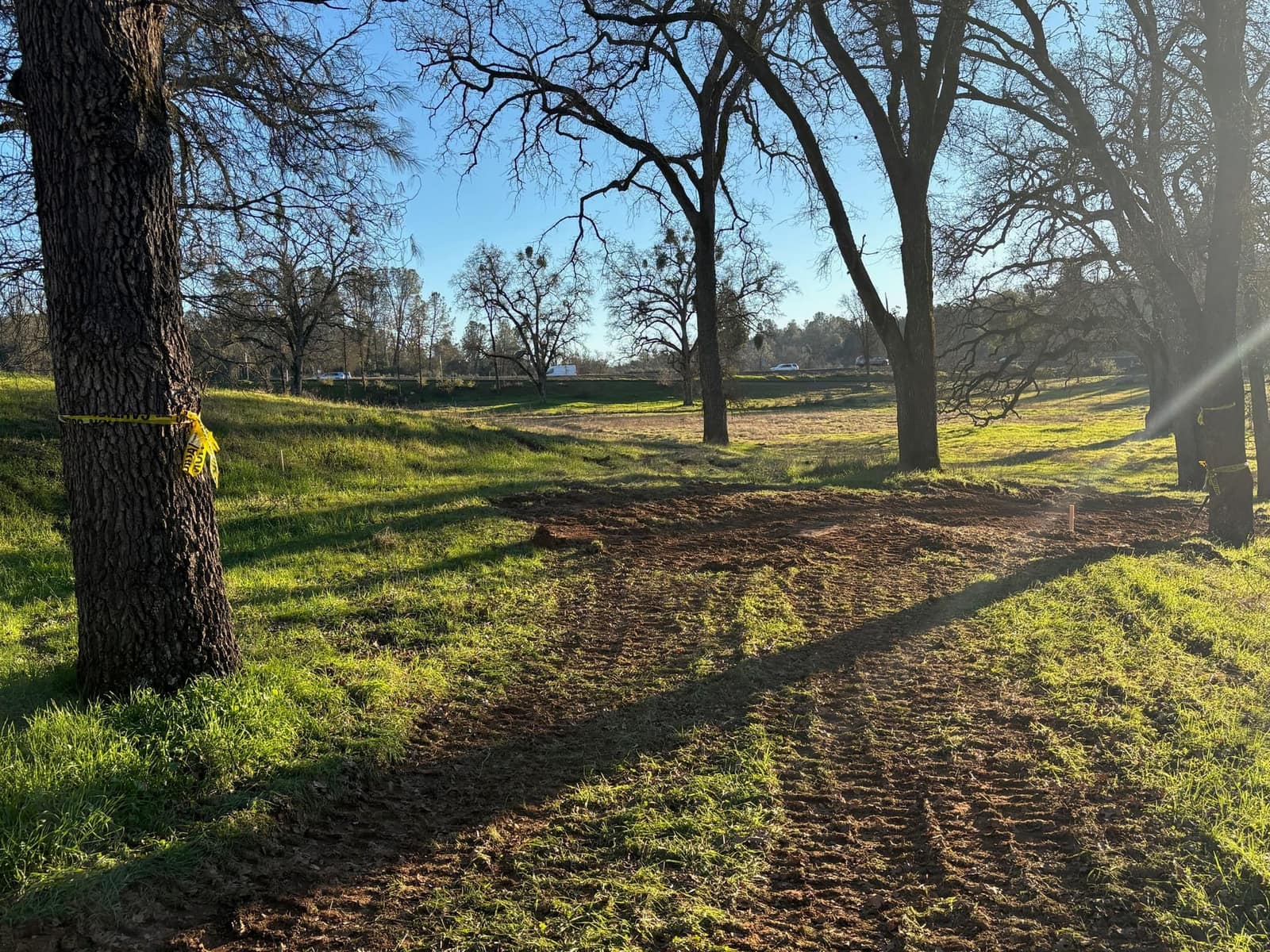
If you are pulling a grading or building permit in El Dorado County and your project is near a native oak, the county will likely require an Oak Technical Report before work begins. The Oak Technical Report is the site specific report a qualified arborist prepares under the county's Oak Resources Management Plan, the program El Dorado County uses to protect native oaks. It is one of the most specific and time sensitive arborist services in the county, and one that general tree services usually cannot provide. I am Christopher Hodge, an ISA Board Certified Master Arborist, and I prepare these reports for property owners and builders.
One thing to sort out first, because these get mixed up. If you are not working from a project plan and simply want to know whether the county will let you take an oak down, that is the removal permit question and it has its own page. This page is about the report: what El Dorado County asks for, what goes in it, and how it is prepared.
The county plan and the report are not the same thing
These two names get mixed up constantly, so here is the difference. The Oak Resources Management Plan, often shortened to ORMP, is El Dorado County's own plan for conserving native oaks, adopted in 2017 and administered alongside the Oak Resources Conservation Ordinance. It sets the rules. The Oak Technical Report, which the county also calls an Oak Resources Technical Report, is the document you submit for your project: the report a qualified professional prepares to show the county how your project meets those rules. The county makes the plan. I prepare the report.
What the county requires in an Oak Technical Report
El Dorado County protects native oaks with a single trunk six inches in diameter or greater, or multi trunk oaks whose three largest trunks total ten inches or more. If a project could affect protected oaks within or next to the grading area, the Oak Technical Report generally includes:
- An inventory of the affected oaks
- An assessment of each tree's health and structural condition
- An impact analysis for the proposed construction
- A protection and mitigation plan meeting county standards
- Preparation and signature by a qualified professional, such as an ISA Certified Arborist
Without an approved Oak Technical Report, permits can be delayed or denied.
How the county measures a protected oak
Diameter is measured at breast height, four and a half feet above the ground, and on sloping ground it is taken from the uphill side. That last detail matters more than it sounds, because a good deal of El Dorado County is on a slope, and measuring from the downhill side of a trunk will read high and can put a tree inside the ordinance that does not belong there, or the reverse.
For a single trunk oak the threshold is six inches. For a multi trunk oak the county adds the three largest trunks together and the threshold is ten inches combined. A Heritage Tree is a different category again, at thirty six inches and above, and it carries the heaviest consequences if it is damaged or removed without approval. The native oaks this applies to around here are blue oak, valley oak, interior live oak, and black oak.
If your trees are anywhere near these numbers, measure before you plan, not after. A project laid out on the assumption that a stand of oaks falls under the threshold is an expensive thing to redraw once someone measures properly.
The exemptions, and the two that catch people out
The ordinance does not treat every oak on every parcel the same way, and there are exemptions. Two of them surprise people often enough to be worth stating plainly.
The first is good news. Trimming a native oak is allowed by right. You do not need county approval to prune your own oak, which surprises owners who have been told that a protected tree cannot be touched at all. Pruning it badly is still a way to lose the tree, so the constraint is arboricultural rather than regulatory, but the permission is there.
The second runs the other way. The exemptions that apply to the other native oaks do not extend to valley oak. If the tree in question is a valley oak, do not assume an exemption you read about covers it, and confirm the species before you act rather than after. Valley oak and blue oak are routinely confused by people who are not looking at them closely, and here that confusion has a price attached.
Oak woodland, canopy, and what mitigation looks like
The county's interest is not only in individual trees. Oak woodland is treated as a habitat resource, and the plan is written around retaining canopy across a site rather than counting stems alone. That is also why oak questions surface in environmental review: Public Resources Code section 21083.4 requires a county to determine whether a project may convert oak woodlands in a way that has a significant effect, and to mitigate it where it does.
Where impacts cannot be avoided, mitigation generally runs along a few familiar tracks: retaining canopy by adjusting the layout, replanting on site, conserving oak woodland elsewhere on the parcel or through an easement, or paying into the county's in lieu programme. Which of these is available, and at what ratio, depends on the project and on current county policy, so the report works those numbers against the ordinance as it stands when you file rather than from a rule of thumb. Avoidance is almost always cheaper than any of the alternatives, which is the main reason to bring an arborist in while the site plan is still moving.
Do not cut first, it can cost three times as much
The most expensive mistake is removing or damaging protected oaks before the permit is approved. When trees come down ahead of permitting, the county can require restitution of up to three times the market value of the replacement trees, and up to nine times for a Heritage Tree. Getting the Oak Technical Report done first is almost always the cheaper path, and it keeps your project on schedule.
Why use Sierra Tree and Fungi
I prepare Oak Technical Reports specifically for El Dorado County's requirements. I know the local ordinance, the county review process, and what reviewers look for, and my reports are complete, professionally formatted, and signed by an ISA Board Certified Master Arborist with TRAQ qualification. I also have no stake in the outcome of your project. I am not a tree crew bidding on removals, so my assessment is independent.
Timeline and scheduling
Most Oak Technical Reports can be completed within 5 to 7 business days of the site visit, with rush turnaround available for time sensitive permits. Call (530) 391-6100 to discuss your project and get a fee estimate before you schedule.
Frequently Asked Questions
Do I need an Oak Technical Report for my building permit?
If your grading or building permit project in El Dorado County could affect a native oak measuring six inches in diameter or greater, or a multi trunk oak whose three largest trunks total ten inches or more, generally at or below 4,000 feet elevation, then likely yes. The county's Oak Resources Conservation Ordinance requires an Oak Technical Report prepared by a qualified arborist before the permit is issued. Without an approved report, the permit can be delayed or denied.
What is the difference between the Oak Resources Management Plan and an Oak Technical Report?
The Oak Resources Management Plan is the county's plan for protecting native oaks. The Oak Technical Report is the report you submit for your specific project, prepared by a qualified arborist, that shows how your project complies with that plan. People often call the report an ORMP, but the report you need is properly the Oak Technical Report.
What counts as a protected oak in El Dorado County?
El Dorado County protects native oak species, including blue oak, valley oak, interior live oak, and black oak, once a single trunk reaches six inches in diameter at breast height, or the three largest trunks of a multi trunk oak total ten inches or more. The inventory measures each oak so the county can confirm which trees the ordinance covers.
How is oak trunk diameter measured?
At four and a half feet above ground, which arborists call diameter at breast height, and on a slope it is measured from the uphill side. For a multi trunk oak the three largest trunks are added together.
Can I trim a native oak without county approval?
Yes. Trimming a native oak is allowed by right in El Dorado County. That said, the ordinance permitting it does not make bad pruning safe: over thinning, topping, or cutting large limbs off a mature oak can start decay that costs you the tree years later. The regulation is not the constraint here, the biology is.
Is valley oak treated differently from the other native oaks?
Yes, and it is the exemption question that catches people most often. The exemptions available for other native oaks do not extend to valley oak. Because valley oak and blue oak are easy to confuse at a glance, identify the species properly before you make a decision based on an exemption.
What is a Heritage Tree in El Dorado County?
A native oak of thirty six inches in diameter or greater. Heritage Trees carry the heaviest restitution exposure in the ordinance: removal or damage without approval can bring restitution of up to nine times the market value of the replacement trees, against up to three times for other protected oaks.
How much does an Oak Technical Report cost?
The cost depends on the number of oaks, site complexity, and the level of mitigation the county requires, so I give a fee estimate after a short conversation about your site and timeline. Remember that removing oaks before the report and permit are approved can cost roughly three times as much, so it pays to start early. Call (530) 391-6100.
El Dorado County and oak woodland sources
- El Dorado County Zoning Ordinance Chapter 130.39, Oak Resources ConservationThe codified ordinance itself, which is the controlling text and is kept current.
- Oak Resources Management Plan, September 2025The county's own plan, the document the Oak Technical Report is prepared under.
- El Dorado County Planning and BuildingThe department that reviews the report and issues the approval.
- Public Resources Code 21083.4, oak woodlandsThe statute requiring counties to address oak woodland conversion in environmental review.
- UC Oaks, Oak Woodland ManagementUniversity of California extension guidance on managing California oak woodland.
- UC Cooperative Extension: Urban Oak CareHow native oaks respond to irrigation, grading, and construction near the root zone.