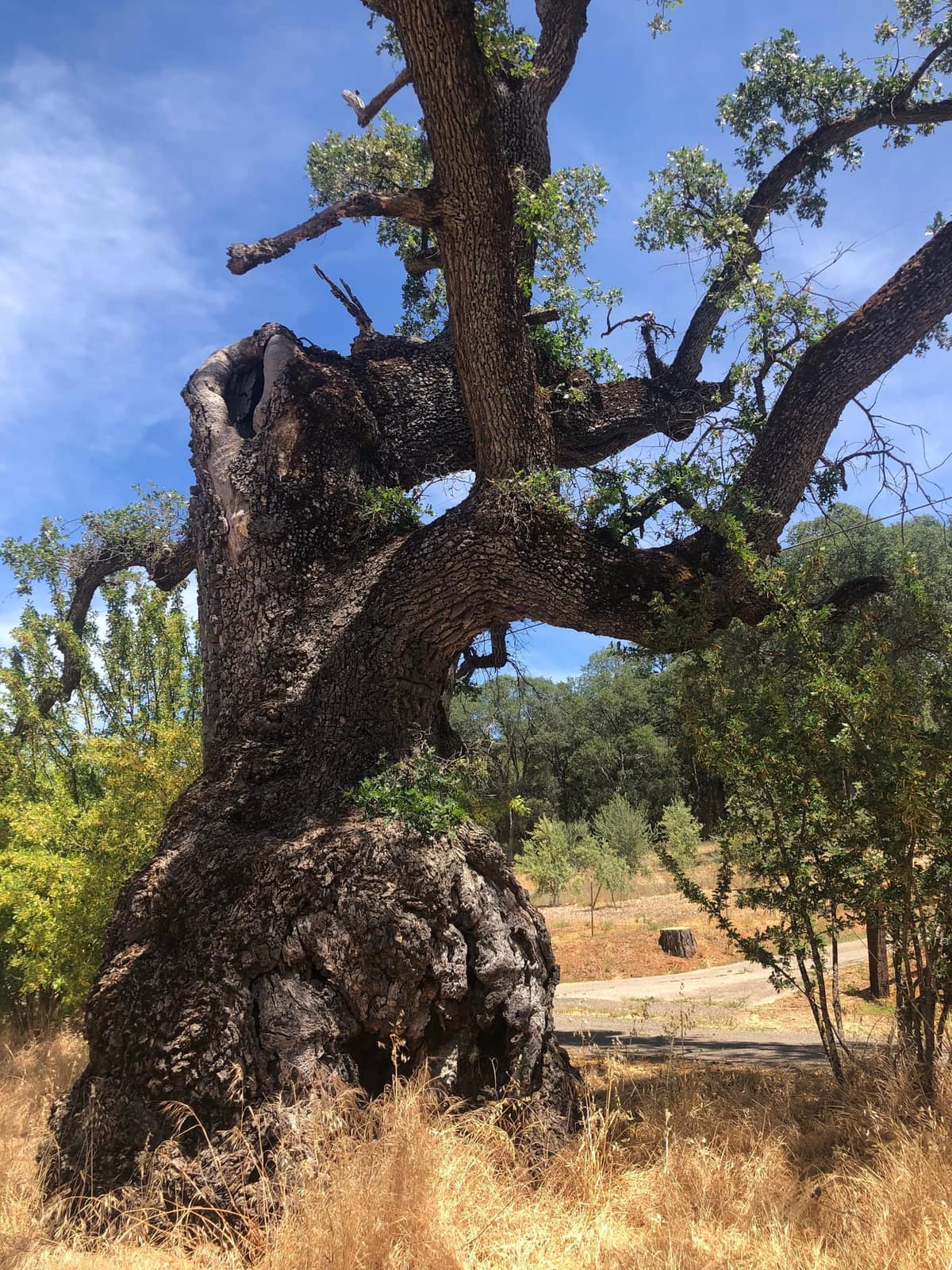
Oaks across the Sacramento region and the Sierra foothills are under pressure from both long established diseases and newer emerging threats, and many of those problems are driven by drought and heat stress. I am Christopher Hodge, an ISA Board Certified Master Arborist working in field and laboratory mycology, and I diagnose oak disease in the field and under the microscope so you know what is actually affecting your tree before you decide what to do. Independent consulting arborist, no removal crews, no stake in whether a tree comes down.
How to identify oak tree disease
Oak tree disease identification starts with where the symptoms show up. On the leaves, look for spotting, blotches, curling, or early browning. On the bark and trunk, look for cankers, oozing, cracked or sunken areas, and the black crusty stroma of charcoal canker. In the canopy, watch for thinning, dieback from the top down, or a single limb wilting. At the base, honey colored mushroom clusters or white fans under the bark point to root disease.
The catch is that many of these signs look alike: a harmless fungus can look alarming while a serious one hides inside the wood. That is why identification, not guesswork, comes first. The photos on this page are real specimens from oaks in our region, examined in the field and under the microscope. This applies across our native oaks, from blue oak and valley oak to interior live oak and coast live oak, and each species has the diseases it is most prone to.
Why oak disease is increasing in our region
Many of the most damaging oak problems are stress diseases. The native oaks that define El Dorado, Sacramento, Placer, and Amador counties, including blue oak, valley oak, interior live oak, and black oak, evolved with our dry summers, but repeated drought, heat, soil compaction, and changes in irrigation can weaken them enough to let normally harmless fungi turn aggressive. The US Forest Service field guide to the insects and diseases of California oaks documents how closely oak decline tracks with this kind of stress.
A field guide to the pests and pathogens of our oaks
The rest of this page is a working field guide to the organisms I diagnose on oaks in the Sacramento region and the Sierra foothills, grouped by how they actually attack a tree. Some rot the wood of the trunk and limbs, some destroy the roots and undermine the tree's stability, some form cankers that girdle branches, some are boring beetles that carry or farm fungi, and a few are sap feeders and leaf problems that look alarming but rarely kill.
Getting the group right is the whole point, because it changes both the outlook for the tree and the right response. Much of my work is with the fungi in particular, identified in the field and confirmed under the microscope. The organism accounts below draw on the US Forest Service field guide to the insects and diseases of California oaks and on University of California research, cited at the end.
Wood decay fungi: what is rotting the trunk and limbs
Decay fungi break down the wood of a living or dead oak, and the kind of rot matters for safety. White rot fungi degrade both the lignin and the cellulose and leave wood that becomes spongy or stringy, while brown rot fungi consume mainly the cellulose and leave a dry, crumbly, cubical residue that loses strength quickly and can fail in a brittle break. A shelf fungus or conk on a trunk is not the disease itself; it is the fruiting body of a fungus that is already decaying the wood inside, so identifying it is a direct part of judging how much sound wood is left and whether the tree has become a hazard.
Laetiporus gilbertsonii, the western sulphur shelf
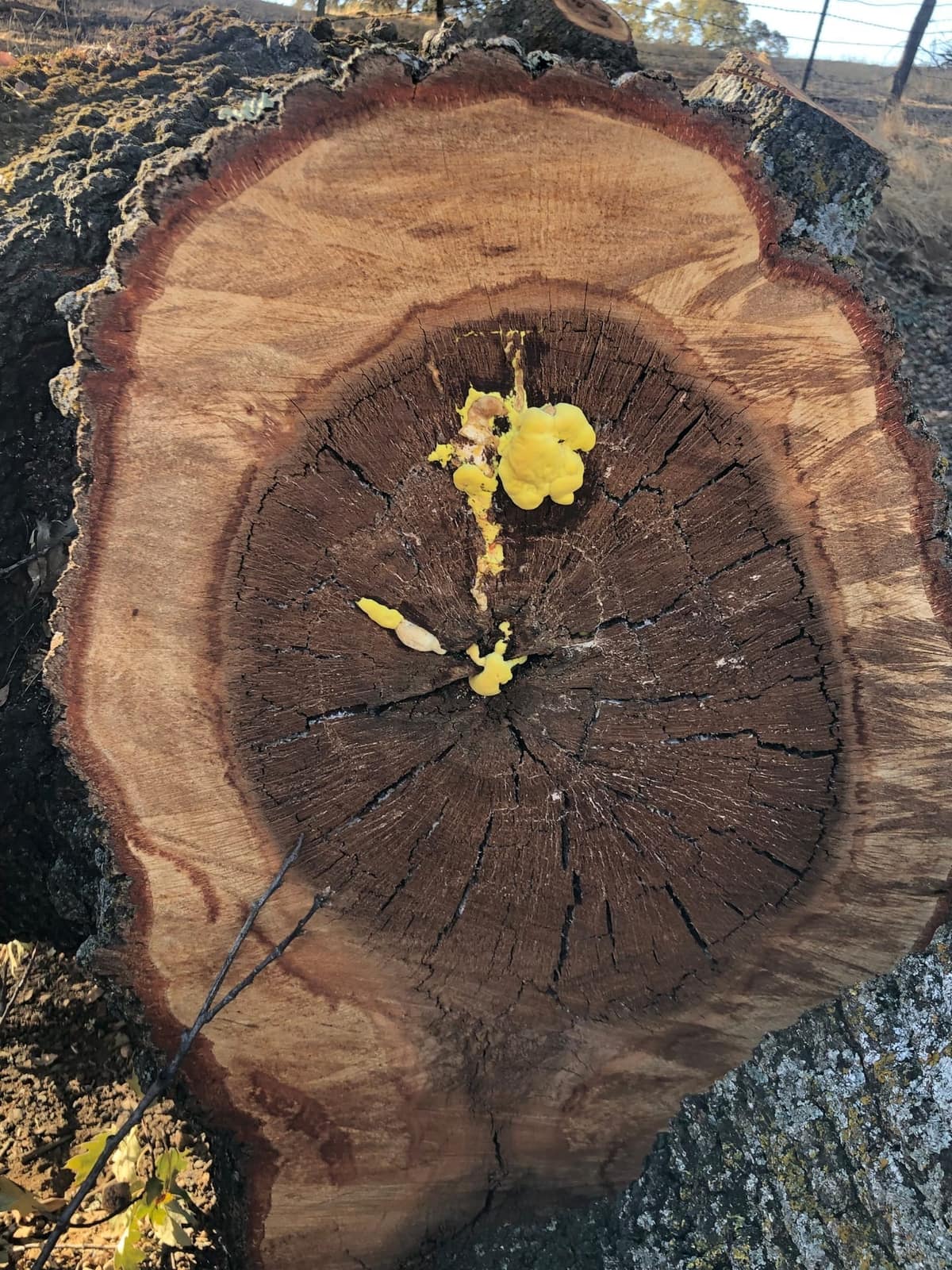
This is the western chicken of the woods, a striking fungus that forms large, overlapping, fan shaped brackets, yellow to salmon orange with a bright yellow pore surface, usually in late summer and fall. On our oaks it causes a brown cubical heart and butt rot, meaning it destroys the cellulose in the heartwood and leaves the wood brittle. Because brown rot takes strength out of wood faster than most white rots do, a fruiting on the trunk or the root crown is worth taking seriously as a structural sign, even though the mushroom itself is famous as an edible.
Inocutis dryophila, an oak heart rot
Once known as Inonotus dryophilus, this fungus causes a white pocket rot in the upper trunk and large branches of oaks, and it is common on California black oak. It usually enters through branch stubs and wounds, then hollows the heartwood into long white pockets separated by firmer wood, while producing thick brown shelf shaped conks on the bole. Like most heart rots it can advance for years inside an otherwise leafy looking tree, which is why decay is so often confirmed by what is fruiting on the trunk rather than by the state of the canopy.
Fomitiporia robusta and related canker rot polypores
The oak polypore long called Phellinus robustus now sits in the genus Fomitiporia, and the North American oak material is best treated as a species group rather than a single European species. These fungi form hard, perennial, hoof shaped conks and cause a spongy white heart rot, entering through pruning wounds and branch stubs and slowly weakening the trunk. They are a good example of why field identification matters, because a hard perennial conk signals a very different, longer running decay than a soft annual mushroom on the same tree.
Fuscoporia ferruginosa, a rusty crust polypore
Once called Phellinus ferruginosus, this fungus was moved into the genus Fuscoporia, a relative of the Fomitiporia and Inocutis polypores above. Instead of forming shelves it grows as a rusty brown, poroid crust pressed flat against the wood, and it is a white rot fungus found mostly on dead and downed hardwood, including oak. On a living tree it is largely a recycler of wood that is already dead, so it usually points to a dead limb or an old wound rather than an active disease, though like any decay fungus its extent and its position on the trunk are what tell you whether it matters for the tree's strength.
Turkey tail and other white rot bracket fungi
Trametes versicolor, the turkey tail, and Cerrena unicolor, the mossy maze polypore, are two of the common white rot bracket fungi you will find on oaks. Both are mainly decayers of dead and wounded wood, so a few brackets on a dead branch stub or an old pruning wound usually mean localized dead wood rather than a disease spreading through a healthy tree. What matters is the amount and the location: abundant fruiting low on a living trunk points to significant internal decay that should be assessed, while a bracket on a long dead limb is simply the fungus doing its job in the ecosystem.
Root and butt rots: the fungi that undermine an oak's stability
Decay in the roots and the base of the trunk is the most serious kind for tree safety, because it attacks the very wood that anchors the tree and resists overturning. These fungi often work unseen until a conk appears at the base or the tree fails outright in wind or saturated soil. When I assess an oak for risk, the root crown is the first place I look.
Armillaria mellea, the oak root fungus
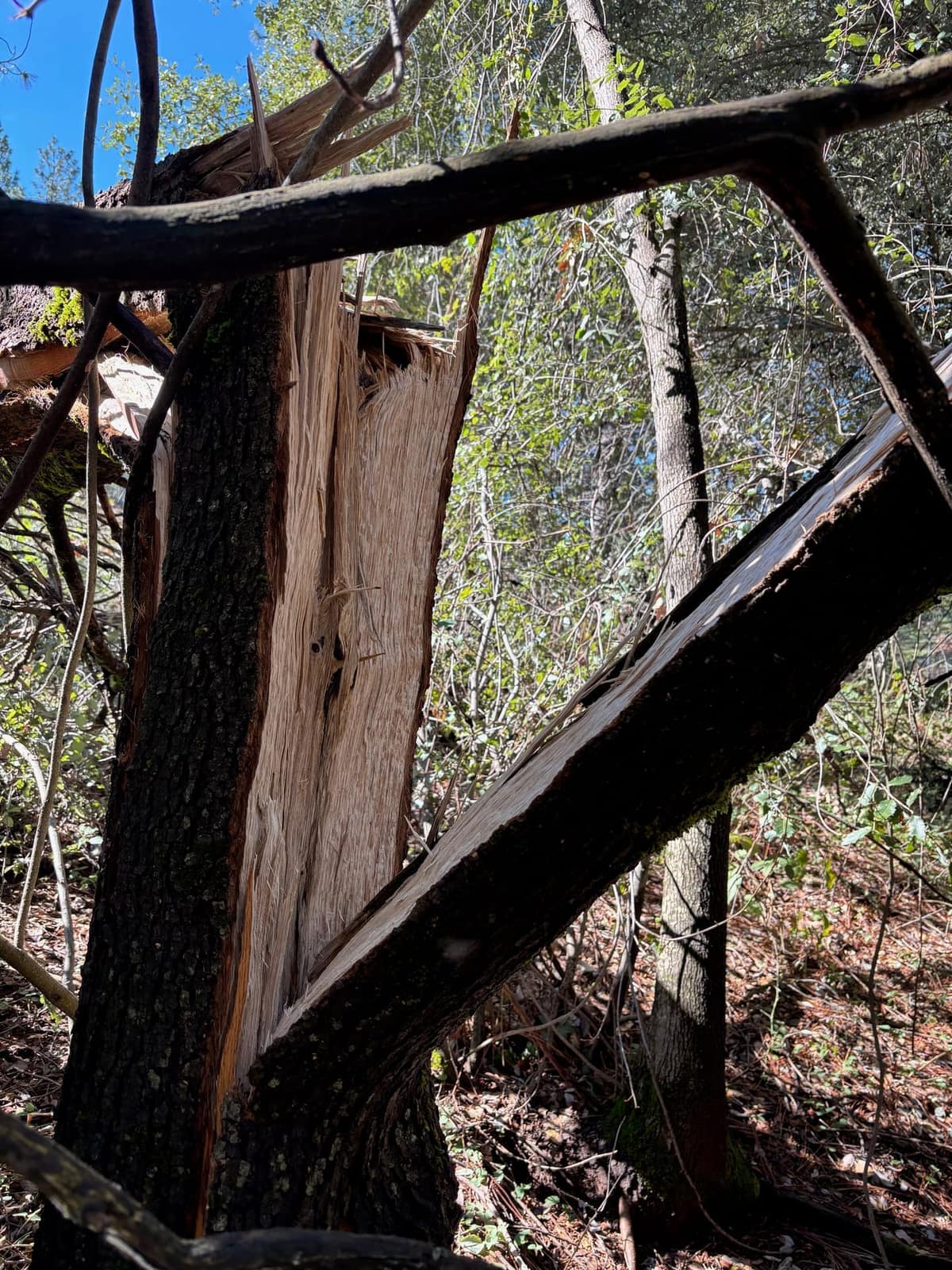
Armillaria root rot, often called oak root fungus, decays the roots and the lower trunk and is one of the most damaging root diseases of oaks in our region. The signs are white, fan shaped mats of fungal tissue between the bark and the wood at the root crown, which often smell like mushrooms, along with dark shoestring strands called rhizomorphs on the roots and clusters of honey colored mushrooms at the base in fall.
Despite the common name it has no real preference for oaks and attacks hundreds of woody plants, and it is especially damaging where irrigated landscaping has been planted over cleared oak woodland, because the extra summer water favors the fungus while stressing natives that evolved with dry summers. It spreads from root to root and survives for years on buried dead roots, which is why an accurate diagnosis matters before replanting.
Ganoderma root and butt rot
Several Ganoderma fungi, including Ganoderma brownii and the artist's conk Ganoderma applanatum, cause a white rot of the lower trunk, the root crown, and the major roots that can hollow the base of an oak and destabilize the whole tree. They announce themselves with large shelf like conks at or near ground level, woody and perennial in the common western species. Because the decay is concentrated exactly where the tree needs strength to stay standing, a Ganoderma conk at the base of a large oak near a house or a driveway is one of the clearer reasons to get a formal risk assessment.
Omphalotus olivascens, the western jack o lantern
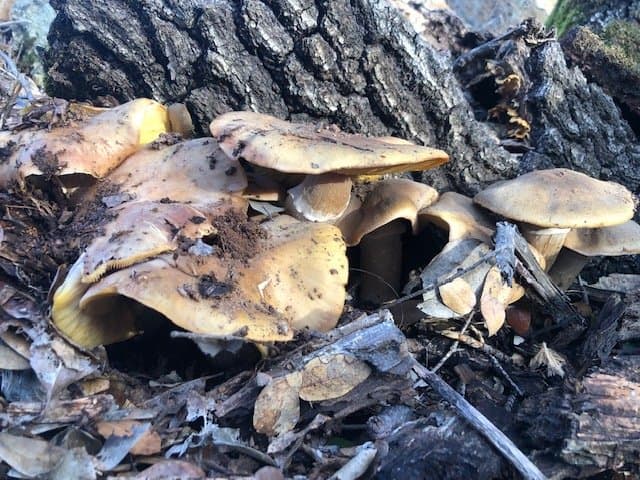
The western jack o lantern is a California native that fruits in dense clusters of orange, gilled, funnel shaped mushrooms at the base of oaks, over buried roots and old stumps, in fall and winter. It is best known for two things: its gills glow faintly green in the dark, and it is toxic, often mistaken for an edible chanterelle. For a tree owner the important point is that it is decaying roots and butt wood, so its appearance at the base of a living oak is a sign of root and butt rot worth investigating. I have written about this species in more detail in the Arborist Notes.

Canker diseases: dead patches that girdle limbs and trunks
A canker is a localized area of dead bark and cambium, and most of the canker diseases on our oaks are driven by stress. The fungus may live quietly in healthy tissue and turn aggressive only after drought, heat, or injury weakens the tree, at which point cankers expand, merge, and girdle limbs, killing everything beyond them.
Biscogniauxia, the charcoal canker
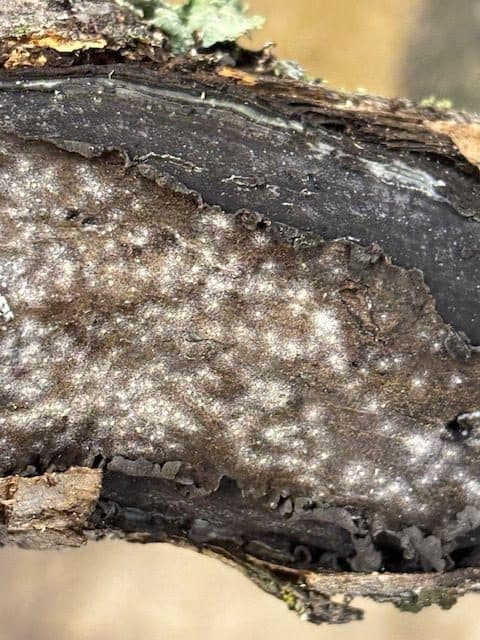
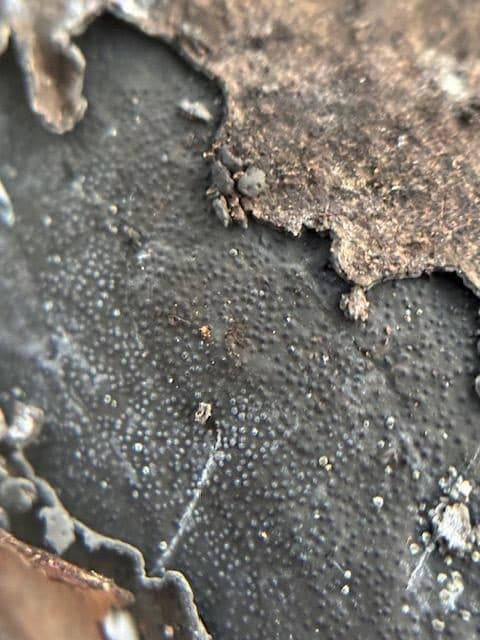
Biscogniauxia canker, also called charcoal canker, is one of the clearest examples of a stress driven oak disease, and I have diagnosed it locally. The fungus, Biscogniauxia mediterranea, lives quietly inside healthy oak tissue as an endophyte and turns pathogenic only when the tree is severely stressed by drought and heat. I examined a stressed blue oak in the El Dorado Hills area that died over the winter, and within a week of inspection the fungus produced its telltale spore mass and then its hard black crust beneath the bark, which I confirmed by spore morphology under the microscope.
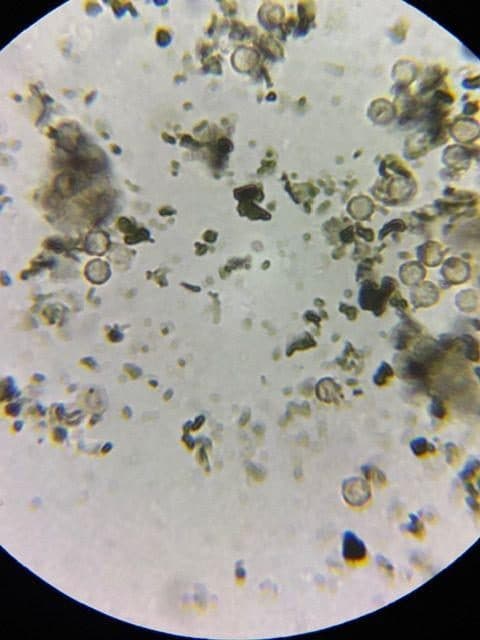
Once it turns aggressive, the fungus decays the sapwood and causes a white sap rot, and elongate cankers develop as the cambium is invaded and killed. As cankers merge they girdle limbs and the crown dies back. This matters for safety as much as for tree health: the outer cylinder of sapwood provides much of a trunk's resistance to failure, so an oak with large Biscogniauxia cankers can become hazardous as that sapwood is lost. The bark falls away in patches to reveal a flat, mat like fruiting surface that starts light brown, turns gray, and finally goes jet black, releasing wind and rain spread spores that can infect nearby oaks.
Because Biscogniauxia is one of the xylariaceous fungi, a group that the mycologist Dr. Lynne Boddy notes is well adapted to growing in dry conditions, it is difficult to control with traditional fungicides or biocontrols. The only reliable defense is keeping oaks healthy enough to resist it through cultural care: appropriate water during extreme drought, protecting the root zone, and avoiding the soil compaction and grade changes that stress the tree in the first place. Early, accurate diagnosis is what makes the difference.
One note on identification: the charcoal canker on our oaks is commonly Biscogniauxia mediterranea in the material I have examined, but a very similar North American relative, Biscogniauxia atropunctata, produces the same kind of black crust on oaks, and telling the two apart is exactly the sort of question that microscopy settles. Both behave as stress fungi, so the management is the same, but naming the organism correctly is part of a defensible report.
Diplodia corticola, bot canker of oak
Bot canker, caused by the fungus Diplodia corticola, is a canker and dieback disease that University of California researchers have documented on California oaks, including coast live oak and canyon live oak. It shows up as crown thinning, bark cracking and staining, and dark bleeding patches on the trunk, with masses of tiny black fruiting bodies on the bark and dark, dead wood underneath that meets the healthy wood at a sharp edge.
It is largely an opportunist that turns aggressive on drought stressed trees, but it is one of the more damaging oak cankers, and its trunk symptoms can look like the damage from wood boring beetles, so laboratory confirmation is what separates a bot canker diagnosis from a borer diagnosis. It was first reported causing bot canker on coast live oak in California in 2010, and on canyon live oak in the same year.
Foamy bark canker, a newer beetle carried disease
Foamy bark canker is a more recent disease of coast live oak, first reported in California in 2014, in which a fungus in the genus Geosmithia is carried into the tree by the western oak bark beetle, Pseudopityophthorus pubipennis. The signature sign is hard to mistake: the beetle's tiny entry holes, about a millimeter across, first ooze a cinnamon colored sap and then push out a prolific cream colored foam that can run down the trunk, with dead reddish tissue in the bark and wood beneath.
The fungus is Geosmithia pallida. It has been most severe in urban Southern California since about 2012, and it has since moved into the central Sierra foothills, including confirmed infections on interior live oak here in El Dorado County, so it is one to know in this region.
Wood boring and bark beetles
Several beetles attack oaks by tunneling into the wood, and the most damaging ones either farm a fungus inside the tree or carry a pathogen with them. Many of them prefer trees that are already stressed, and because they travel inside cut wood, moving or storing oak firewood is one of the main ways they reach new areas.
The Mediterranean oak borer
The Mediterranean oak borer is an invasive ambrosia beetle, Xyleborus monographus, that is now spreading rapidly in Sacramento County, and it is one of the most serious emerging threats to our valley oaks. The beetle tunnels into the wood and farms symbiotic fungi inside the tree as food for its larvae, and those fungal gardens can damage and kill the oak over time.
It was first detected in California in Calistoga, in Napa County, in 2019, and has since been confirmed in Sacramento County, where it is spreading rapidly, as well as El Dorado, Yolo, and Mendocino counties. It attacks the white oak group. Valley oak (Quercus lobata) and blue oak (Quercus douglasii) are the main California hosts, along with Oregon white oak farther north, and the full range of susceptible oaks is still being studied.
The beetle usually colonizes a tree from the upper canopy downward, so the early signs are wilting, defoliation, and dieback in the crown, along with broken branches and dark staining in the wood from the fungi. The entry holes are tiny, about one sixteenth of an inch across, at thin or cracked bark. Because the beetle moves in infested wood, one of the most important things you can do is not move or store oak firewood from an affected area. If you have a declining valley oak in the Sacramento area, it is worth having it looked at early.
Oak ambrosia beetles, Monarthrum species
Two native ambrosia beetles, Monarthrum scutellare and Monarthrum dentiger, bore into oaks that are already injured or unhealthy, along with tanoak and California buckeye. The sign is very fine white boring dust around the entry holes and gathered at the base of the tree, with deep pinhole tunnels running into the pale heartwood.
These beetles are secondary, meaning their presence usually tells you the tree is already in decline, and University of California research has shown that their tunneling and the fungi they introduce can predispose coast live oak to faster wood decay and structural failure. It is worth being clear that these Monarthrum beetles are not the insect behind foamy bark canker, which is the separate western oak bark beetle described above.
The oak twig girdler, Agrilus angelicus
The oak twig girdler in California is Agrilus angelicus, a flatheaded borer, and it is a different insect from the longhorned twig girdlers of the eastern and southern states, a distinction worth making because the two are often confused.
The larva mines and spirals inside a twig, effectively girdling it, and then bores down the branch, so the visible symptom is scattered patches of dead, whitish brown leaves hanging in an otherwise green canopy, a pattern called flagging. It has a roughly two year life cycle and is mostly disfiguring rather than deadly, but heavy repeated attacks can thin a canopy, and the flagging is easy to mistake for a more serious problem, which is another reason to confirm the cause.
Sap feeders and foliar problems
The insects and fungi in this group are usually cosmetic on an established oak, but they are worth identifying because heavy infestations on young or stressed trees can matter, and because they are so often mistaken for something worse.
Kuwana oak scale
This is a scale insect found on blue oak and live oaks, with red females and cyst like immature stages that sit on the bark. There is a nice piece of California natural history attached to it: the scale on our oaks was long filed under the Japanese species Kuwania quercus, but in 2013 researchers described the California material as a distinct native species, Kuwania raygilli, recorded across the counties around Sacramento. In practice it is a minor curiosity rather than a tree killer, but correctly naming what is on the bark keeps a report honest.
Oak powdery mildew
Powdery mildew on oaks, caused by fungi in the genus Erysiphe, once grouped under the name Microsphaera, appears as a white, powdery coating on leaves and new shoots. It is favored by mild temperatures, shade, and humid air, and it can distort the tender new growth of young trees and nursery seedlings, but it rarely threatens the health of an established oak. Management, when any is needed, is usually cultural, improving air movement and light rather than reaching for a fungicide.
Bacterial wetwood, or slime flux
Wetwood is not a single disease organism but a bacterial fermentation inside the wood. Water soaked, discolored wood in the trunk or a large branch develops internal pressure that forces a sour smelling, dark reddish fluid out through bark cracks and old wounds, staining the bark in a way that looks alarming. It is most common in older trees, it rarely does serious harm on its own, and there is no cure that eliminates it, so the sensible response is to keep the tree healthy and avoid the wounds that give it an entry, rather than to try to sterilize it away.
What we do not have here: oak wilt and the coastal diseases
Ruling a disease out is as much a part of an honest diagnosis as ruling one in. Oak wilt, caused by the fungus Bretziella fagacearum, is a devastating disease in the eastern and central United States, but it has never been recorded in California, so a declining oak here is not dying of oak wilt no matter what a search result suggests.
Sudden oak death, caused by the water mold Phytophthora ramorum, is a genuine killer, but it is primarily a coastal, fog belt disease that depends on wet conditions and a California bay laurel reservoir, and it is not established in the drier Sacramento Valley or the Sierra foothills, although California black oak and canyon live oak, which also grow here, are susceptible where the pathogen and a wet climate coincide. Naming the real problem, and clearing the trees of the ones they do not have, is exactly what a field and laboratory diagnosis is for.
What to do if you think your oak is diseased
Diagnosis is also the cheaper path. A medium sized oak removal near a house commonly runs $1,500 to $4,000, and a mature valley or blue oak cannot be replaced in a lifetime. Several of the conditions on this page look alarming and are survivable, and a few look minor and are not. Knowing which one you have costs far less than acting on the wrong assumption.
Start with a diagnosis, not a chainsaw. Many fungi on and around oaks are harmless or even beneficial, and some serious diseases look similar to minor ones, so the first step is identifying exactly what is present. I inspect the tree, take samples when needed, and confirm the organism under the microscope or in culture, then give you a written report with the findings, what they mean for the tree's health and safety, and the realistic options.
Because I run no removal crews, that advice is based on the tree, not on selling you a cut, and where a report points to root or soil work I can do myself, I say so in it. A site assessment with that written report starts at $500. The site visit on its own is $250 and covers up to one hour on site. Call or text (530) 391-6100.
How a tree disease diagnosis works
A diagnosis starts before I touch the tree. I ask what changed: new irrigation, a trench, a patio, fill soil over the roots, a dry year. Most tree disease in the Sacramento area follows a stress, and the stress is often older than the symptoms.
Then I work from the ground up. The soil and the root collar come first, then the trunk, the main limbs and the canopy. I keep signs and symptoms apart. A sign is the organism itself: a conk, a mushroom, a black stroma, a beetle gallery. A symptom is the tree's response: thinning, dieback, bleeding, wilting. Symptoms narrow the list. Signs name the cause.
When the sign is there and the name is not certain, I take a sample. Spores and tissue go under the microscope, and where it is needed the organism is grown in culture. The name matters because two fungi that look alike on the bark can mean very different things for the tree.
You get a written report: what is present, how I know, what it means for the health and safety of the tree, and what your options are.
Diseases of other Sacramento area trees
This page is about oaks, but oaks are not the only trees I diagnose. These four diseases are well documented by the University of California on other common trees of the Sacramento area.
Dutch elm disease
The leaves yellow and wilt, usually first in one part of the canopy, then turn brown, curl and stay on the branch. Under the bark the wood shows brown to blackish streaks. It is spread by elm bark beetles, through root grafts between neighboring elms, and by moving infested elm wood. The University of California reports that it has killed several thousand elms in California, mostly in the San Francisco Bay Area and around Sacramento.
Anthracnose on sycamore and London plane
California sycamore is very susceptible. In a cool, wet spring the new leaves brown along the veins and drop, and twigs die back. It looks alarming and is usually not serious: the disease does not badly harm a tree unless the defoliation, dieback or cankering comes back every year. The Bloodgood variety of London plane is resistant.
Fire blight on pear
A bacterial disease. Flowers and young shoots wilt and turn black, the shoot tips bend into a crook, and the dead leaves hang on as if the branch had been scorched. Pear is extremely susceptible, and among the ornamental pears the Aristocrat variety is rated highly susceptible.
Verticillium wilt
A fungus that lives in the soil and plugs the water conducting wood. Maple, ash, Chinese pistache, elm, redbud and olive are among its hosts. Foliage fades, yellows and wilts in scattered parts of the canopy, often on one side first, and the wood under the bark of an affected branch can show dark streaks. It stays in the soil, so what gets planted in that spot afterward matters.
Frequently Asked Questions
Can a diseased oak be saved?
Sometimes, and it depends entirely on the disease and how far it has progressed. A stress disease like Biscogniauxia canker often cannot be cured once the cankers are extensive, but catching decline early and reducing the underlying stress can preserve a tree for years. The only way to know is an accurate diagnosis, which tells you whether you are managing a treatable problem or a tree that has become a hazard.
Is the Mediterranean oak borer in the Sacramento area?
Yes. The Mediterranean oak borer was first found in California in Napa County in 2019 and is now spreading rapidly in Sacramento County, with detections also in El Dorado and Yolo counties. It primarily attacks valley oak. If a valley oak in your area is wilting and dying back from the top down, it is worth an inspection.
Should I treat my oak with a fungicide?
Usually not, and not before a diagnosis. Many oak diseases in our region, including Biscogniauxia canker, are not effectively controlled by fungicides, and the fungus may be one your oak normally tolerates. The most effective approach is almost always cultural: identify the stress, correct it, and keep the tree healthy enough to defend itself.
What diseases affect oak trees in the Sacramento area?
The oaks here face a mix of established and emerging problems. The ones I diagnose most are Armillaria root disease, the oak root fungus that attacks the roots and lower trunk; Biscogniauxia charcoal canker on drought stressed oaks; and the invasive Mediterranean oak borer, an ambrosia beetle now confirmed in Sacramento County. Others include bot canker, various wood decay fungi that rot the trunk and limbs, root and butt rots such as Ganoderma, and minor sap feeders and leaf problems. Sudden oak death is the well known threat on the coast, but it is not established in our drier foothills.
How can I tell what is wrong with my oak tree?
Start by noting where the trouble is: the leaves, bark, trunk, canopy, or the base of the tree. That narrows the list, but it rarely settles it, because many oak diseases look alike and some of the most serious ones work inside the wood where you cannot see them. I confirm the organism in the field and, when needed, under the microscope, so the diagnosis is right before any treatment or removal decision. Call or text (530) 391-6100.
Can my oak have oak wilt?
No. Oak wilt is a serious disease in the eastern and central United States, but it has never been recorded in California, so it is not the cause of an oak declining here. Something else is going on, whether a stress canker, a root rot, a boring beetle, or simple drought stress, and identifying which one is the first step. It is a common online misdiagnosis worth putting to rest.
What does it mean if mushrooms or conks are growing on my oak?
It depends on the fungus and where it is growing. Many mushrooms near an oak are harmless or even beneficial partners of the roots, but a firm shelf or conk growing from the trunk, the root crown, or a major root is usually the fruiting body of a wood decay fungus that is already rotting the wood inside, which can matter for the tree's safety. That is exactly the kind of thing worth identifying, because the species tells you whether you are looking at a harmless recycler on a dead branch or a decay fungus undermining a living trunk.
Do you diagnose tree diseases other than oak diseases?
Yes. Oaks are most of the native canopy here, so they are most of this page, but I diagnose pines, cedars, redwoods, sycamores, elms, maples and fruit trees the same way, in Sacramento, El Dorado, Placer and Amador counties.
How much does tree disease diagnosis cost in the Sacramento area?
A site assessment with a written report starts at $500. The site visit on its own is $250 for up to one hour, with no report. If a sample needs microscopy or culture to settle the identification, I give you that cost before I do the work.
Can you diagnose a tree disease from a photo?
A photo is a good start, and you can text one to (530) 391-6100. Sometimes it is enough to rule something out. It is not enough for a diagnosis I would put in writing, because the roots, the soil and the inside of the wood do not show up in a picture.
University of California and USDA resources
- U.S. Forest Service Field Guide to Insects and Diseases of California OaksThe standard USDA reference, PSW-GTR-197, by Swiecki and Bernhardt, covering the insects and diseases described on this page.
- UC IPM: Oak Branch Canker and DiebackUniversity of California guidance on Diplodia corticola and related oak canker fungi.
- UC IPM: Oak Ambrosia BeetlesThe Monarthrum oak ambrosia beetles and the western oak bark beetle that carries foamy bark canker.
- UC IPM: Oak Twig GirdlerThe California oak twig girdler, Agrilus angelicus, and the flagging it causes in the canopy.
- UC IPM: Armillaria Root RotUniversity of California guidance on Armillaria root rot, the oak root fungus.
- UC IPM: Wetwood, or Slime FluxUniversity of California guidance on bacterial wetwood and slime flux.
- UC IPM: Sudden Oak DeathThe UC IPM Pest Notes on Phytophthora ramorum and why it is chiefly a coastal problem.
- UC Agriculture and Natural Resources: Mediterranean Oak BorerThe University of California resource tracking the Mediterranean oak borer across the state.
- UC IPM: Dutch Elm DiseaseWhere the disease occurs in California, how it spreads, and its symptoms.
- UC IPM Pest Note: AnthracnoseAnthracnose on sycamore, London plane and other landscape trees.
- UC IPM Pest Note: Fire BlightHosts, symptoms and the susceptibility of ornamental pear varieties.
- UC IPM: Verticillium WiltHost trees, symptoms in woody plants, and replanting advice.
Peer reviewed research
- Lynch, Eskalen, Zambino and Scott (2010), Plant DiseaseFirst report of bot canker caused by Diplodia corticola on coast live oak in California.
- Úrbez-Torres, Peduto, Rooney-Latham and Gubler (2010), Plant DiseaseFirst report of Diplodia corticola causing trunk cankers and dieback of canyon live oak in California.
- Lynch, Wang, Mayorquin, Rugman-Jones, Stouthamer and Eskalen (2014), Plant DiseaseFirst report of foamy bark canker, caused by Geosmithia pallida with the western oak bark beetle, on coast live oak in California.
- Wu, Nan, Gullan and Deng (2013), ZootaxaDescribes the California oak scale as a distinct native species, Kuwania raygilli.
Sources
- Swiecki, T.J. and Bernhardt, E.A. 2006. A Field Guide to Insects and Diseases of California Oaks. General Technical Report PSW-GTR-197. Pacific Southwest Research Station, Forest Service, U.S. Department of Agriculture.
- Sierra Tree and Fungi lab analysis of Biscogniauxia mediterranea on Quercus douglasii, with reference to the 2017 Western Arborist article on Biscogniauxia pathogenicity.