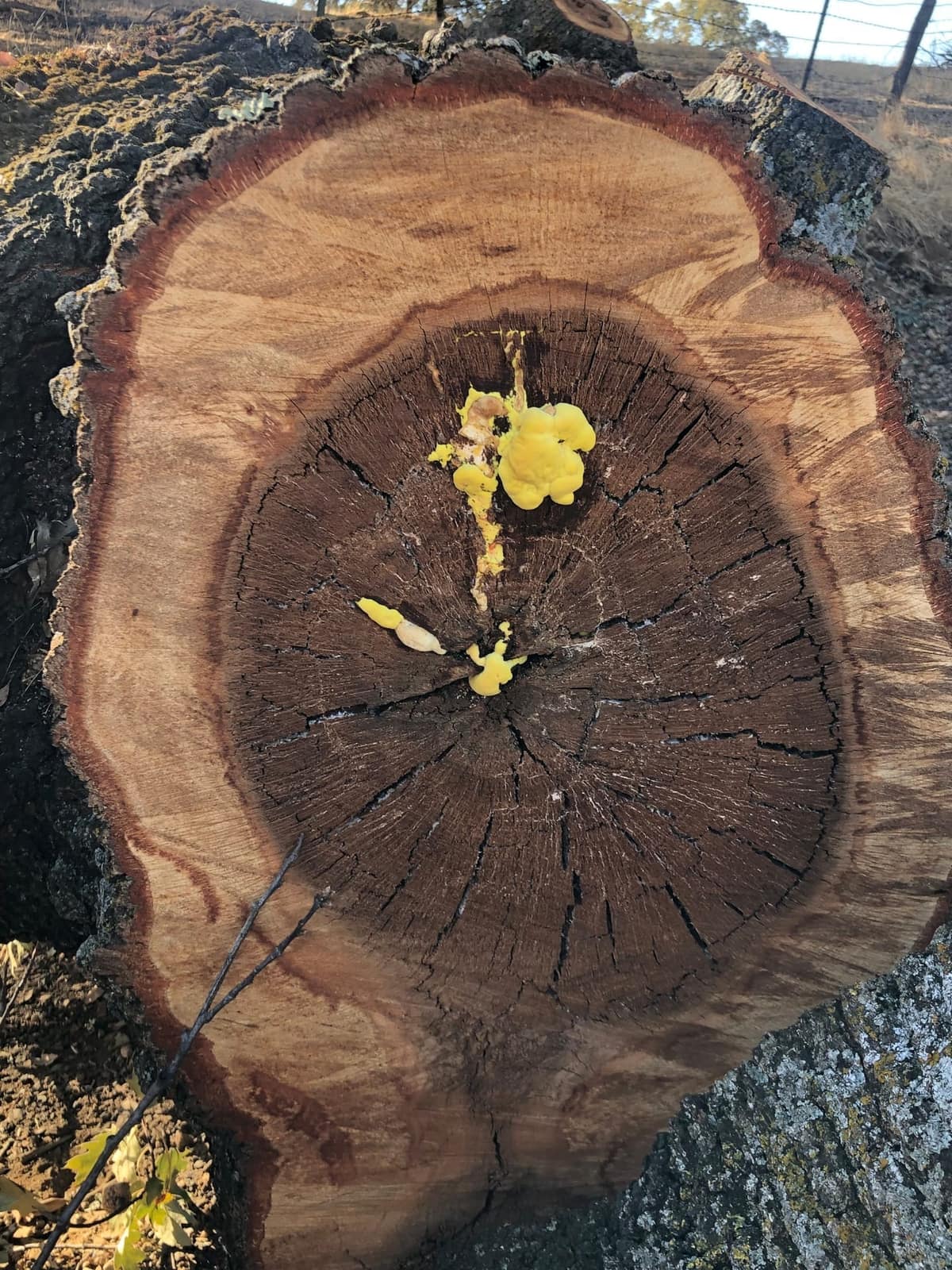
Plant health care is the practice of keeping a tree healthy by managing the conditions it grows in, and treating a pest or pathogen only once the cause has actually been identified. It is the opposite of spraying on a calendar. I am Christopher Hodge, an ISA Board Certified Master Arborist, TCIA Plant Health Care Technician, and California licensed Qualified Applicator, and I run no removal crews, so nothing in a plan of mine exists to sell you a cut. Where a plan points to root or soil work I can do myself, I say so in the report.
Almost everything that matters in this work happens below the ground, and in roughly this order: the roots, the soil they sit in, the organisms living alongside them, and only then the pest or pathogen everyone noticed first.
It starts with the roots
Most of what kills established trees in this region arrives through the root zone, and almost none of it is visible from a driveway. The absorbing roots that actually take up water and nutrients sit in the top foot or two of soil and reach well past the branch tips, which is why damage done twenty feet from a trunk still shows up in the canopy three years later.
The root problems I find most often, in rough order of how much damage they do:
- A buried root collar. The flare where the trunk widens into the roots should be visible at grade. When soil, mulch, or fill covers it, the bark stays wet, and bark that stays wet decays.
- Girdling roots, which grow against the trunk or root flare and slowly strangle the tissue that moves water and sugars. A tree can carry one for a decade and then decline quickly.
- Severed roots from trenching, grading, or a driveway that went in closer than anyone measured.
- Compaction from vehicles, equipment, or simply years of foot traffic over the root zone.
Where the flare is buried or roots need inspecting, I excavate with compressed air rather than a shovel, which moves soil without cutting the roots I am trying to look at. That work has its own page, because it is a service in its own right as well as a diagnostic step.
Soil health is the other half of the tree
A healthy soil is roughly half solids and half pore space, and that pore space is the point. Roots respire, which means they need oxygen, and the same pores carry the water and hold the biology. Compaction crushes that structure, and a compacted soil starves roots of air while shedding water off the surface instead of letting it in. It is the single most common site problem I see, and it is usually invisible until someone puts a probe in the ground.
What actually helps, in the order I usually reach for it:
- Decompaction, opening the soil without tearing the roots apart, which is another job an air spade does well.
- Mulch, applied two to four inches deep over the root zone and pulled back clear of the trunk. Mulch moderates temperature, holds moisture, feeds soil life as it breaks down, and keeps mowers away from the bark. Piled against the trunk it does the exact opposite, which is why the mulch volcano is such a persistent problem.
- Correcting irrigation. More foothill oaks are damaged by a sprinkler running against the trunk through summer than by any pest on this page.
- Organic matter and targeted amendment, decided by what the soil actually lacks rather than by habit.
Fertilizer deserves a caution. A stressed tree is not usually a hungry tree, and pushing nitrogen into one that is struggling for water or air produces soft growth it cannot support and can make pest problems worse. I test and look before feeding, and quite often the answer is that the tree needs air and water rather than nutrients.
The organisms already working for your tree
This is the part of plant health care most often skipped, and it is the part I have spent my career on. A tree is not an individual so much as a partnership. Its roots live in a web of fungi and bacteria, and the great majority of them are either helping the tree or doing nothing to it at all.
The most important of those partners are the mycorrhizal fungi, which colonize roots and effectively extend the tree's absorbing surface far beyond what its own roots could reach. They deliver water and nutrients, particularly phosphorus, and take sugars in return. Oaks, pines, and firs, which is most of what grows here, form ectomycorrhizal partnerships, and many of the mushrooms that appear under them in the fall are the fungal partner fruiting rather than anything attacking the tree. Compaction, bare soil, and heavy fungicide use all suppress this community, and mulch and organic matter both encourage it.
The practical consequence is that a mushroom near a tree is not automatically bad news. Some fungi are aggressive pathogens, some decay only wood that is already dead, some are feeding the tree, and telling them apart is a laboratory question rather than a matter of opinion. That is the whole reason identification comes before treatment.
Biological control is a real and promising field, and it is worth being straight about how far it has actually got. A 2024 review of Trichoderma against Armillaria found 31 of 34 studies reported effective control, working through mycoparasitism, antibiosis, competition, and changes to the soil community. The same review found non volatile metabolites from one Trichoderma species increased rhizomorph growth in several Armillaria species, and a field trial on nectarine failed to improve survival at all. Its own summary is that results are convincing in the laboratory and in short outdoor trials, while durability in the field remains far from clear. So I will build soil biology deliberately, and I will not sell you an inoculant as a cure.
Identifying the pest or pathogen properly
Only after the site has been read does the organism become the question, and here the standard I hold is that a name is either established or it is not. According to UC IPM, most disorders of landscape trees are abiotic, meaning they come from non living causes such as drought, overwatering, buried root collars, compaction, or mechanical injury. Pests and pathogens are frequently the second event, moving into a tree that was already weakened, which is why treating the insect you can see often changes nothing.
Where the question is fungal, I culture and identify the organism rather than reading symptoms from outside the bark. That means isolating it onto malt extract agar or potato dextrose agar and examining spore and hyphal structures under the microscope, using stains such as lactophenol cotton blue and Congo red where contrast is needed. Fungal taxonomy is what I have spent over fifteen years studying, and it is why people bring me the trees that are hardest to explain.
Identification changes the answer completely. Two trunks showing the same amount of visible decay can carry very different risk depending on which fungus is inside, because brown rot leaves brittle wood that fails suddenly while white rot leaves wood that keeps more of its ability to bend. Naming the organism is not academic detail; it decides whether a tree is retained, reduced, monitored, or removed.
Bark beetles and wood boring insects
In the Sierra foothills and the Sacramento region, bark beetles are the most lethal pest of drought stressed conifers. The western pine beetle and the engraver beetles attack ponderosa and other pines, and the fir engraver, Scolytus ventralis, attacks white fir. On oaks, the invasive Mediterranean oak borer, an ambrosia beetle, now threatens valley oaks in El Dorado and Sacramento counties.
The signs to call about are pitch tubes on the trunk, fine reddish boring dust in the bark crevices and at the base, a crown fading from green through yellow to red, and woodpeckers stripping patches of bark. Be clear about the timing though: once beetles are established under the bark and the crown has gone red, no treatment brings that tree back. What is still decidable at that point is the trees around it, whether their stress can be corrected, and whether a preventive treatment on high value specimens is worth doing before the next flight.
Pathogens and tree diseases
Fungal and other pathogens cause root rots such as Armillaria and Heterobasidion, along with cankers, vascular wilts, and foliar diseases. Many of them look alike from the outside, and their prognoses are not remotely alike. Some are managed culturally, some respond to a targeted material at a specific point in the season, and some have no cure at all once established, which is the honest position on Armillaria. I will tell you which of those situations you are in rather than selling a treatment into a case that cannot respond to one.
When a treatment is actually applied
I do not spray on a schedule. The sequence is diagnosis, then correcting the underlying stress through water, soil, and root zone management, and then a targeted treatment only where the evidence supports it. That protects beneficial insects and the fungi described above, which blanket spraying does not.
On licensing, so it is unambiguous. I hold a California Qualified Applicator License, which means I can apply control materials. I am not a Pest Control Adviser, and in California writing the material recommendation is the PCA's licensed function, so that is not something I do. Where a written recommendation is required, I will say so and tell you who needs to provide it.
When the plan includes work I do myself
I perform root and soil work: root collar excavation, root pruning, decompaction, and amendment. So a plant health care plan sometimes points at a job I can carry out. Where that happens I say so plainly in the report, so you can weigh the finding knowing I have an interest in the remedy, and you are free to take the report to anyone you like. I do no branch pruning and no removal at all, which means nothing in my findings is quietly steering you toward a cut.
What plant health care costs
A site assessment with a written report starts at $500, and includes the diagnosis, the evidence behind it, and a plant health care plan you can act on. The site visit on its own is $250 and covers up to one hour on site. Laboratory identification, root and soil work, and treatment are quoted separately, and I will tell you the cost before any additional work begins.
Set that against the alternative. Removal of a medium sized tree near a house commonly runs $1,500 to $4,000 and is the one option you cannot undo, and a great deal of what I am called to turns out to be a watering pattern, a grade change, or a compacted root zone.
University and research sources
- ISA, Plant Health CareThe International Society of Arboriculture on what plant health care is and how it differs from reactive treatment.
- UC IPM: Landscape Tree Damage, It Is Not Always a Pest IssueThe basis for treating abiotic site causes before pests and pathogens.
- ISA: Proper Mulching TechniquesDepth, placement, and why mulch piled against a trunk causes the damage it is meant to prevent.
- UC IPM: Bark BeetlesThe California reference on the pine and fir bark beetles discussed above.
- UC IPM Pest Notes: Armillaria Root RotThe root disease with no labeled cure, and how it is managed culturally instead.
- Poveda, Millen and Bailey (2024), Biological Control 188:105424The open access Trichoderma review behind the biological control section, including its negative results.
- UC Cooperative Extension: Urban Oak CareHow native oaks respond to irrigation, grade change, and disturbance in the root zone.
- CAL FIRE Forest Entomology and Pathology ProgramState level monitoring of the forest insects and diseases affecting this region.
Frequently Asked Questions
What is plant health care?
It is managing a tree's health through the conditions it grows in, meaning its roots, soil, water, and the organisms around it, and treating a pest or pathogen only after the cause has been identified. It is preventive and diagnostic rather than a spray schedule, and most of the work happens below ground.
Are the mushrooms around my tree a problem?
Not necessarily, and often the opposite. Many fungi around oaks, pines, and firs are mycorrhizal partners feeding the tree. Others decay only wood that is already dead. A few are aggressive pathogens. Which one you have is the entire question, and it is answered by identifying the organism rather than by how it looks in a photograph.
Should I fertilize a tree that looks unhealthy?
Usually not as a first move. A stressed tree is rarely a hungry tree, and adding nitrogen to one short of water or oxygen produces soft growth it cannot support and can make pest problems worse. Test first. Far more often the answer is relieving compaction, correcting irrigation, or uncovering a buried root collar.
Do you spray pesticides on a schedule?
No. I diagnose the specific problem, address the cause, and apply a targeted treatment under my Qualified Applicator License only where one is warranted. That protects beneficial insects and fungi and keeps unnecessary materials off your property.
Can you treat my tree's disease?
Sometimes, and it depends entirely on the disease and how far it has gone. Foliar and shoot diseases often respond well when treated at the right point in the season. Wood decay and established root disease do not, because the organism sits where nothing applied to the outside reaches it. An accurate diagnosis tells you which case you are in before you spend anything.
What are the signs of bark beetles in my tree?
Pitch tubes on the trunk, fine reddish boring dust in the bark crevices and at the base, a crown fading or turning red, and a sudden increase in woodpecker activity stripping bark. On conifers these usually follow drought. Beetles move quickly once established, so an early assessment is what protects the neighboring trees.
Can soil compaction really kill a tree?
Yes, and it is one of the most common causes I find. Roots need oxygen, and compaction collapses the pore space that holds it while also shedding water off the surface. The decline is slow and easy to blame on something more visible, which is why compacted trees are so often treated for a pest instead.