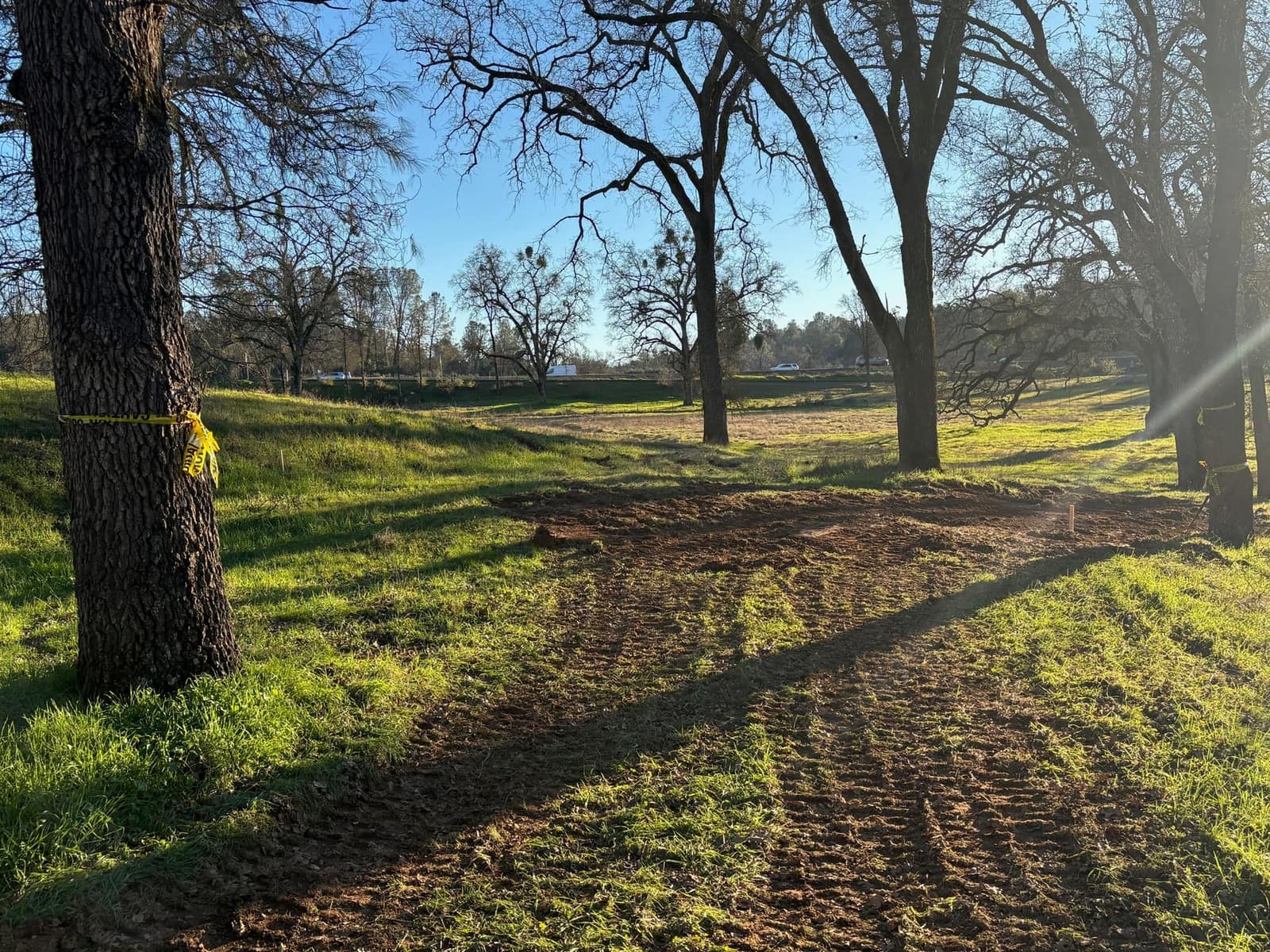
The first thing to settle here is which rulebook you are under. Inside the city limits, Chapter 161 of the Auburn Municipal Code applies. Step across the line into the unincorporated land surrounding the city and a county ordinance takes over, with different thresholds and different mitigation. I am Christopher Hodge, an ISA Board Certified Master Arborist, and I write the tree reports these permits are built on. I run no removal crews, so the rating I put on a tree is an assessment, not a sales pitch.
Chapter 161, and what changed in 2025
The tree preservation chapter began as Ordinance 03-5, effective July 23, 2003, and was amended by Ordinance 25-05 on October 27, 2025. Anything written before that date should be checked against the current text. The chapter is short enough to read in one sitting, and I recommend doing that before any project that touches a mature tree.
This ordinance is not only about oaks
A protected tree is any native tree with a trunk at least 6 inches in diameter at breast height, or with multiple trunks where at least one trunk reaches 6 inches or the trunks total at least 20 inches. That 20 inch aggregate is unusual; the county next door uses 10. The species list matters more. Native tree covers the valley, blue, interior live, canyon live, black and oracle oaks, and it also covers California buckeye, Pacific madrone, incense cedar, western redbud, ponderosa pine and Douglas fir. A madrone or an incense cedar nobody would regulate in a neighboring city is protected here.
Two permits, and the twenty percent line
Which permit you need turns on how far a project reaches into the critical root zone, defined as a circle with a radius equal to the largest dripline radius plus one foot. Stay within 20 percent of that zone, with no discretionary project and no removal, and the work can go through an administrative tree permit from the Community Development Department. Cross 20 percent, involve a discretionary project, or remove a protected tree at all, and it goes to the Planning Commission. That threshold is measured rather than estimated.
The tree rating drives the mitigation
The base rule is one inch of replacement for every two inches of trunk diameter removed. It is then scaled by the tree rating carried in the project tree report, on a scale of one to five. A rating of one requires no mitigation at all, two cuts the requirement in half, three and four hold it at the full figure, and five raises it to 150 percent. Stock size converts inches into trees: a fifteen gallon tree or three five gallon trees count as one inch, a 24 inch box as two, a 36 inch box as three, a 48 inch box as four. No more than a quarter of the requirement may be met by revegetation, which carries a security of 150 percent of the plan cost. The rating step is where a documented report earns its cost.
Exemptions worth knowing before you hire anyone
Several ordinary situations need no permit. A developed single family lot under an acre in a single family residential zone is exempt, as is an undeveloped lot in that zone which was under an acre when the ordinance was adopted. On a developed single family lot over an acre, approved plans for an addition, a second unit, a pool, a driveway or an accessory structure are exempt where no discretionary entitlement is involved, and so is removal of up to five protected trees per calendar year. Trees certified dead, dying, in poor health or hazardous are exempt, and so is work done to comply with defensible space requirements provided for by law. Read that last one carefully: the exemption is for complying with a legal requirement, not for clearing you decided on yourself.
A city sitting on a jurisdictional seam
The city is in the local responsibility area, and mapped hazard classes inside it run from nonwildland through moderate and high to pockets of very high. Sample points just outside the city limits come back as state responsibility area. So a home inside town takes its clearance obligation from Government Code section 51182 in the very high pockets, while a property a mile out in the canyon country is under Public Resources Code section 4291 instead. Sampled points are not a parcel determination, so check the address in the CAL FIRE viewer below.
Canyon ground and the species that suits it
Canyon live oak is worth naming because the code protects it and the terrain suits it. The species holds steep rocky slopes, ravines and canyons across a range from 300 to 9,000 feet in California, on ground blue oak will not take. On sloping lots the practical problems are root plate disturbance from cut and fill, compaction along equipment access, and pruning done for a view. Minor trimming has a definition here: it stops being minor once it substantially reduces crown size or density, alters the natural shape, or cuts live wood over 3 inches in diameter.
What I do here
- Project tree reports carrying the documented ratings that mitigation depends on
- Critical root zone encroachment analysis against the twenty percent threshold
- Tree risk assessment on sloping and canyon edge lots
- Native tree inventories covering madrone, cedar, pine and fir, not only oaks
- Condition assessment supporting dead, dying or hazardous determinations
Start with a site visit
A site assessment with a written report starts at $500. The site visit on its own is $250 and covers up to one hour on site. For a project heading to the Planning Commission, that report is the first step rather than the last, because the ratings and encroachment numbers set what the city will ask you to plant. Call or text (530) 391-6100. If the parcel sits outside the city limits, county permits for the surrounding unincorporated area are filed at 3091 County Center Drive, and I prepare those reports too.
Book a consultationFrequently Asked Questions
Is my property under the city ordinance or the county one?
Settle that before anything else, because the numbers differ. Inside the city limits, Chapter 161 of the Auburn Municipal Code applies. Outside them, the surrounding unincorporated land falls under Placer County Article 19.50, Woodland Conservation, a separate ordinance with a different multi trunk rule, different thresholds and different mitigation. I confirm the jurisdiction before writing anything, and county filings go to the county agency offices on County Center Drive.
Does the ordinance protect trees other than oaks?
Yes, and this is where the city departs from most of its neighbors. Alongside six native oaks, the code protects California buckeye, Pacific madrone, incense cedar, western redbud, ponderosa pine and Douglas fir. A native conifer on your lot can be a protected tree here even though the same species is unregulated a few miles down the hill.
How much replacement planting will a removal cost me?
Start with one inch of replacement for every two inches of diameter removed, then scale by the tree's rating: nothing at rating one, half at two, the full amount at three and four, and 150 percent at five. Stock size converts inches into trees. A cash contribution to the city Tree Mitigation Fund is allowed where planting is not feasible, at a per tree cost set by City Council resolution.
What happens if a tree comes down without a permit?
A violation of the chapter is a misdemeanor. Where protected trees were removed with no permit and no security posted, the owner both replaces them under the mitigation rules and pays a fine equal to the replacement value of the trees. The City Council may also deny or defer any development application on that property for up to three years, which on a financed project is usually the larger cost.
Official ordinance and permit sources
- Auburn Municipal Code Chapter 161, Tree PreservationThe full chapter as amended by Ordinance 25-05 in October 2025, including the protected tree definition, permit types, the tree rating mitigation table and enforcement.
- City of Auburn tree permit informationThe city handout explaining the difference between a tree permit and an administrative tree permit and what a submittal has to include.
- CAL FIRE fire hazard severity zone viewerCheck whether an address falls inside the local responsibility area or the surrounding state responsibility area, and which hazard class applies.