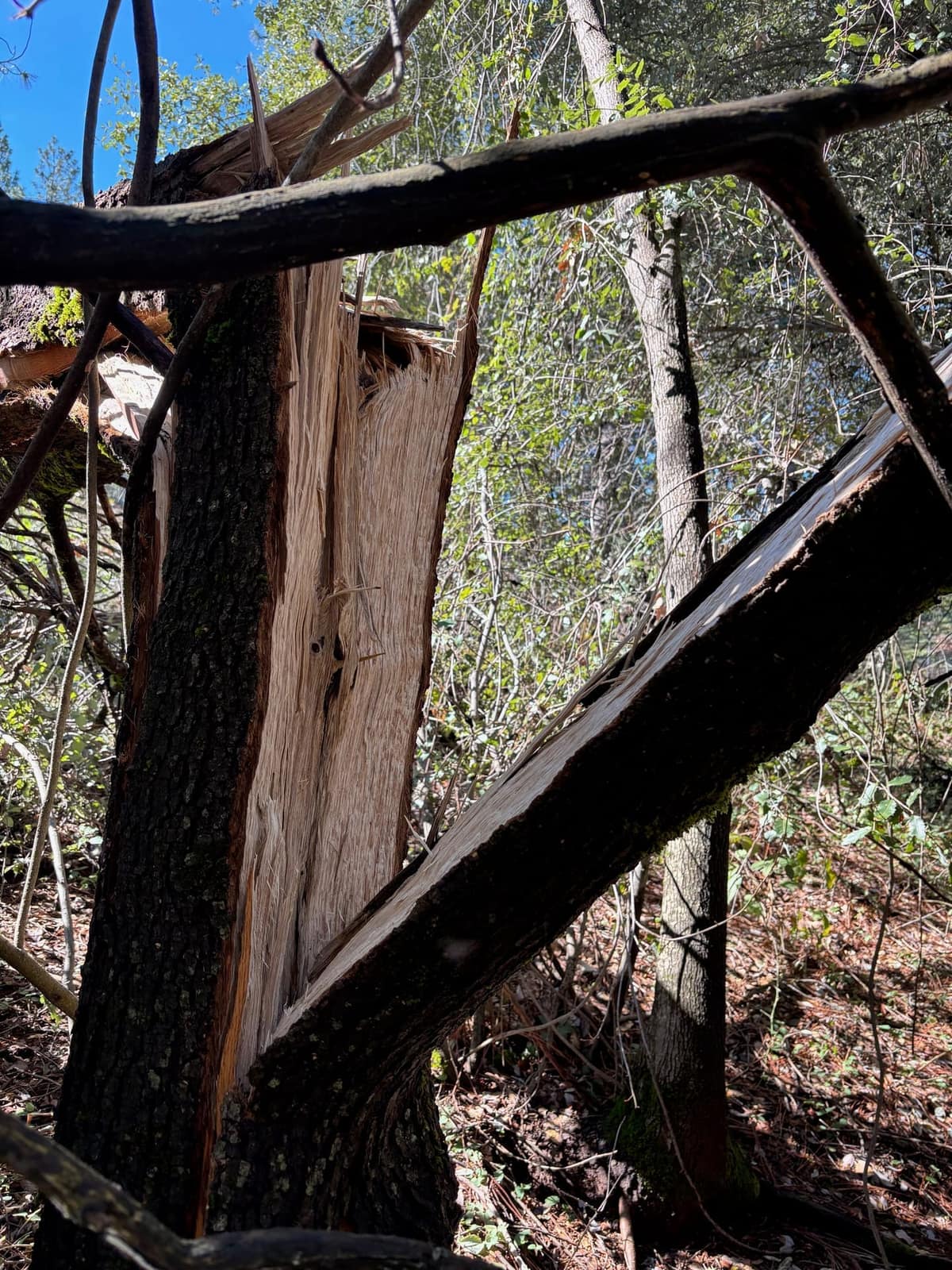
The fastest way to tell whether a tree is dead is the scratch test. Scrape a small patch of the thin outer bark off a twig with your thumbnail or a knife. If the layer underneath is green and slightly moist, that part of the tree is alive. If it is brown, dry, and brittle, that part is dead. Check several places, high and low, because a tree can be dead in one limb and perfectly alive in the rest of it.
That answers whether it is dead. It does not answer why it is dying, which is the more useful question and the one this page is really about.
Dead and dying are two different questions
Almost everything written on this subject runs the two together, which is why so much of it is unhelpful. They are not the same problem and they do not have the same answer.
Whether a tree is dead is a binary question. There is either living tissue under the bark or there is not, and you can settle it yourself in a few minutes with the checks below. Whether it is dying, and whether you can stop it, is a diagnosis. That asks what is driving the decline, whether the cause is still acting, and whether it can be reversed before the tree passes the point of no return. Most people arrive asking the first question and actually need the second one answered.
What this looks like on foothill species
The checks below are general, but the answers are local. In El Dorado, Placer, and Amador counties the trees I am called about are mostly blue oak, interior live oak, valley oak, and California black oak, along with ponderosa pine, gray pine, sugar pine, incense cedar, and Douglas fir. Each of them fails on its own schedule.
The conifers are the urgent ones. A ponderosa or gray pine that fades from green to straw to red has usually been finished by bark beetles working under the bark, and by the time the needles turn there is nothing left to save. The oaks are slower and more forgiving. A blue oak can carry thin canopy and dieback for several seasons and still recover if the cause is found and corrected, which is why I would rather look at a struggling oak in spring than write it off in August.
The checks you can do yourself
None of these require a professional, and doing them before you call anyone will make the conversation far more useful:
- The scratch test. Scrape a small patch of outer bark on a twig, then repeat on a larger branch and on the trunk. Green and moist underneath means living tissue. Brown and dry means dead tissue. Work from the twigs inward, because a tree usually dies from the extremities back.
- The bud check. Live buds are plump and slightly pliable, and a cross section is green inside. Dead buds are shriveled, dry, and snap off cleanly.
- The twig bend. A living twig has some give and bends before it breaks. A dead one snaps clean with no flex at all, like a dry pencil.
- Look at the whole crown from a distance. Note whether the thinning is even, starts at the top, or is confined to one side. That pattern is diagnostic, and it is the single most useful thing you can tell an arborist over the phone.
- Walk the base and look at the ground. Mushrooms, cracked or heaving soil, a change in the lean, or a trunk that enters the ground like a telephone pole with no visible flare are all worth reporting.
One timing trap. A deciduous tree in winter looks completely dead and usually is not, and an oak that leafs out weeks later than its neighbors has not necessarily failed. If it is the dormant season, trust the scratch test and the buds rather than the bare canopy, and if you can, wait until the tree has had a fair chance to leaf out before deciding anything permanent.
Signs a tree is dying, and what each one actually means
The value is not in the list; it is in what each sign points at. These are the ones worth acting on:
- Dieback that starts at the top or at the branch tips and works inward. Classic pattern for a root or water conducting problem. The tree is failing to supply its furthest tissue first.
- A thinning crown with undersized, off color foliage. Usually chronic stress rather than an acute event, and often the site rather than a pest.
- Premature fall color or early leaf drop. The tree shutting down ahead of schedule to cut its losses, frequently water related.
- Epicormic sprouts, the thin shoots that erupt straight from the trunk and major limbs. A stress response, and a serious one, but read it correctly: the tree is still trying. It is a warning, not a death certificate.
- Mushrooms or hard shelf conks at the base, on buttress roots, or on the trunk. The most important sign on this list. When the fungus is a decay species, its fruiting bodies mean it is already well established inside the wood, because the visible mushroom is the last stage, not the first.
- Bleeding, oozing, or sunken dead patches on the bark. Cankers and vascular problems, which need the organism identified before anything sensible can be said.
- Bark falling away in plates, often with pale patches where woodpeckers have worked. On a conifer that usually means beetles under the bark.
- Fine reddish boring dust in the bark crevices, or popcorn sized blobs of pitch. Bark beetle attack on a pine or fir. Time sensitive.
- Soil heaving or cracking on one side of the trunk, or a lean that has changed. Root plate movement. Treat this as urgent, because it is a structural failure warning rather than a health one.
The signs that usually mean it is not coming back
Being straight about this saves people money. Some findings mean the decision has already been made and the remaining question is how to take the tree down safely rather than how to save it:
- Well developed conks of an aggressive root or butt rot fungus at the base or root crown, once the extent of the decay shows it has cost the tree its structural strength as well as its health.
- A conifer whose whole crown has faded to yellow or red with beetles established under the bark. There is no treatment that reverses this, and the useful question becomes which neighboring trees can still be protected.
- Root plate movement, heaving soil, or a fresh lean. The tree may still be alive and is now a hazard, which is a different problem entirely.
- No living tissue anywhere on the scratch test, no live buds through a full growing season, and bark sloughing over most of the trunk.
The signs that look fatal and usually are not
This list saves more trees than the last one, because these are the ones that get healthy trees removed:
- Lichen and moss on the bark. These are the most misdiagnosed things on a tree. Lichens are not parasites and take nothing from the tree. They grow on the bark surface, not in the wood, and are common on perfectly healthy trees. They are sometimes more visible on a thinning tree simply because more light reaches the bark, which is probably how the myth started.
- One dead limb on an otherwise full crown. Trees shed branches routinely, particularly shaded lower ones. Worth pruning, not worth panicking about.
- Leaf scorch, brown margins on the leaves in late summer. Usually water related and usually correctable.
- A bare canopy in winter on a deciduous tree. Covered above, and still one of the most common false alarms there is.
- Normal inner needle shed on a conifer. Pines and firs drop their oldest interior needles every year. Browning confined to the inside and lower parts of the crown, with green tips, is usually this and not a pest.
Can a dying tree be saved?
Often, yes, and it depends almost entirely on the cause. Most decline that I get called to is abiotic, meaning it comes from non living site conditions: watering patterns, a grade change, compacted soil, a buried root collar, or root damage from construction. Those causes are frequently correctable, and a tree that is caught while it still has most of its crown will usually respond.
What does not reverse is advanced root disease, extensive internal decay, and beetle attack that has already succeeded. The honest framing is that you are buying information first. Removal of a medium sized tree near a house commonly runs $1,500 to $4,000 and is the one decision you cannot undo, so it is worth knowing which case you are in before you spend that.
After the cause, time matters more than anything else here. A tree that has lost a third of its crown has far more options than the same tree two seasons later, and the causes that are easiest to fix are the ones that show the fewest symptoms early.
A dead tree is a different problem from a dying one
Once a tree is dead it stops being a health question and becomes a structural one. Decay continues after death, the wood loses strength, and the failure point moves. How long that takes varies enormously with species, size, and which organisms are working on it, so nobody can responsibly give you a number of years.
What matters is what is underneath it. A dead tree in the middle of a pasture is wildlife habitat and can often be left. The same tree over a driveway, a roof, a road, or anywhere people gather is a risk that needs assessing and usually removing. If that is your situation, a tree risk assessment is the service that answers it, and I am TRAQ qualified to carry one out.
What I do when you are not sure
I diagnose declining trees for a living, and the part I am known for is the fungal side: where a decay fungus or a pathogen is involved, I identify the organism by culture and microscopy rather than guessing from the outside of the bark, because the name of the fungus changes the prognosis completely.
A site assessment with a written report starts at $500, and includes the diagnosis, the evidence behind it, and a plan you can act on. The site visit on its own is $250 and covers up to one hour. I am an independent consulting arborist and I run no removal crew, so I have nothing to gain from telling you a tree has to come down. Where the report points to root or soil work that I can perform myself, I say so plainly in the report so you can weigh the finding knowing that. Call (530) 391-6100 and describe what the tree is doing.
University and arboricultural sources
- UC IPM: Landscape Tree Damage, It Is Not Always a Pest IssueWhy most tree decline traces back to site conditions rather than an insect or disease.
- UC IPM: Diagnosing the Causes of Unhealthy PlantsThe diagnostic sequence used to separate abiotic causes from pests and pathogens.
- UC IPM Pest Notes: Wood Decay Fungi in Landscape TreesWhat conks and mushrooms on a trunk indicate about the condition of the wood inside.
- ISA, Managing Tree Hazards and RisksThe International Society of Arboriculture on when a declining or dead tree becomes a risk.
- ISA, Tree Owner InformationGeneral guidance for owners on tree condition, care, and when to call a professional.
- UC ANR: Oaks in the Urban Landscape, Biotic and Abiotic DisordersCostello and colleagues on how oaks decline in built landscapes, which is most of this region.
Frequently Asked Questions
How can I tell if a tree is dead?
Use the scratch test. Scrape a small patch of outer bark off a twig, a branch, and the trunk. Green and moist underneath means that part is alive; brown, dry, and brittle means it is dead. Combine it with a bud check, because live buds are plump and pliable while dead ones snap off dry. Test several places before concluding anything, and if it is winter, do not judge a deciduous tree by its bare canopy.
How do you know if a tree is dying?
Dying shows as a pattern rather than a single sign: a crown that thins from the top or the branch tips inward, undersized or off color leaves, early leaf drop, epicormic sprouts on the trunk, and deadwood accumulating through a living crown. The shape of the dieback usually points at the cause, which is why it is worth noting where the thinning started rather than just that it is thinning.
Can a dying tree be saved?
Frequently, if the cause is caught early and is correctable. Most decline comes from site conditions such as watering, grade changes, compaction, or a buried root collar, and those respond well. Advanced root disease, extensive internal decay, and established bark beetle attack do not reverse. An honest assessment tells you which case you are in rather than selling you treatment either way.
Does moss or lichen on the bark mean my tree is dying?
No. This is the single most common misconception I get asked about. Lichens are not parasites and take nothing from the tree, and moss grows on the bark surface rather than in the wood. Both are found on completely healthy trees. They can look more prominent on a declining tree simply because a thinner canopy lets more light onto the bark, which is almost certainly how the idea started.
My tree has mushrooms growing at its base. Is it dying?
It is a sign worth taking seriously, because if it is a decay fungus, the fruiting body means it is already well established in the wood rather than just arriving. But it is not automatically fatal, and which fungus it is changes the answer completely: some are aggressive pathogens, some only decay wood that is already dead, and some are doing nothing to the tree at all. That is worth identifying properly rather than guessing.
My tree has no leaves in spring. Is it dead?
Not necessarily. Species leaf out at different times, and a stressed tree often leafs out late, unevenly, or with smaller leaves before recovering. Give it until the species around it are well into leaf, then use the scratch test and the buds. If there is still green tissue under the bark, the tree is alive and the question becomes why it is struggling.
How long before a dead tree falls?
There is no reliable number, and be cautious of anyone who offers one. It depends on the species, the size, which decay organisms are present, and the weather it gets exposed to. What can be assessed is the tree's current condition and what sits within its falling distance, which is what a tree risk assessment is for.
Should I remove a dead tree straight away?
It depends entirely on what is underneath it. A dead tree away from anything that matters is valuable wildlife habitat and can often stay. A dead tree over a house, a driveway, a road, or a place people gather should be assessed promptly and will usually need removing. I do not run a removal crew, so I can tell you which situation you are in without any interest in the answer.