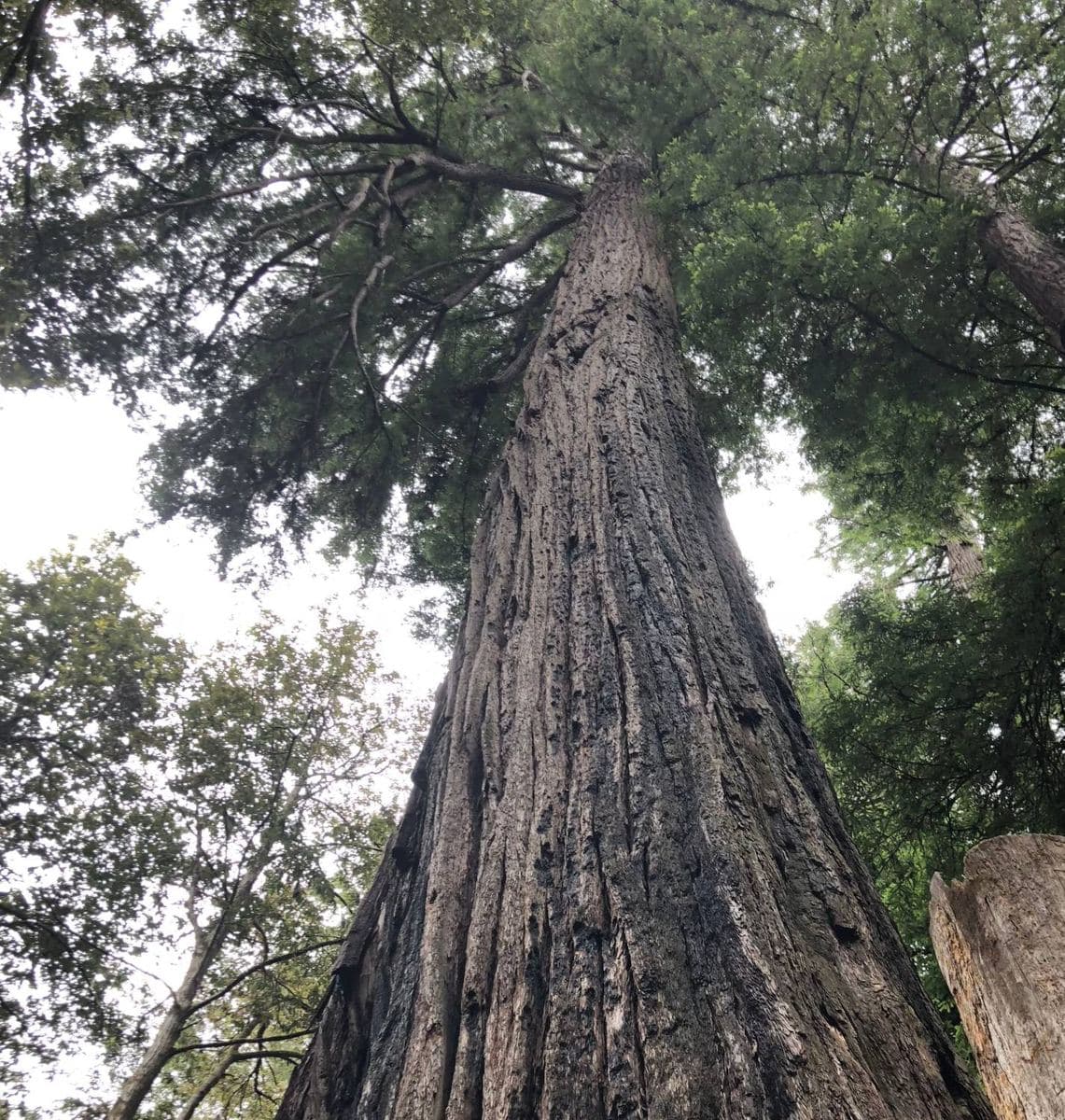
As an arborist born and raised in Northern California, I have fond memories of climbing giant redwood stumps in the North Coast forests as a kid, so I appreciate people wanting to bring some of the redwood forest charm to their landscape. Here in the Sacramento area and the Sierra foothills, they are a beloved ornamental tree that can provide ample shade.
However, though native to California, these trees are restricted to the coastal fog belt, which has cooler summer weather that is often damp with fog, and that fog becomes a source of their summer water. So in the warm interior of California, supplemental summer water is the biggest limiting factor for their growth and health. We often see trees that don't get enough water, or have their water cut off, suffer stress, sometimes attack by pathogens that take advantage of the stressed trees, and often a slow decline. Here are some tips to maintain healthy redwoods through the summer heat, built on University of California research and recommendations.
Why a redwood struggles away from the coast
Coast redwood grows naturally only along the coast of California and southern Oregon. The UC Davis Arboretum, which has kept a redwood grove alive in Davis since 1941, explains the water math on its grove signs: on the coast, redwoods comb moisture out of the summer fog and get roughly a quarter to half of their yearly water that way, with the rest from winter rain. Their foliage stays cool and shaded in a forest of other redwoods, and the fog drip lands on a mat of shallow roots built to catch it.
None of that exists in the Sacramento Valley or the foothills. There is no summer fog, the afternoons are hot and dry, and a landscape redwood usually stands alone in full sun. The Arboretum's own summary is plain: redwoods are high water users that will always need extra summer water, young trees need water year round, and redwoods planted here never look as healthy as they do on the coast. When the grove was first planted, students kept the young trees alive by carrying buckets from Putah Creek.
The research on declining trees points the same way. A statewide Plant Disease study in 2018 described coast redwood as one of the most widely planted landscape trees in California and in decline outside its natural range from prolonged drought and plant pathogens. The researchers sampled declining trees at eleven coastal and inland locations and recovered five different canker fungi, the Botryosphaeriaceae, from branch dieback. Water stress is the door those fungi walk through.
Water first: how to irrigate a redwood through the summer
Adequate irrigation is the single most important thing you can do for an inland redwood. This is how I set it up, following University of California guidance:
- Water deeply and slowly, not often and shallow. UC Master Gardeners in San Luis Obispo County, another place redwoods are grown outside their range, recommend long, deep soakings that keep the top 18 inches of soil moist but not soggy, and put a mature redwood's summer need at roughly 10 gallons a day, or about 70 gallons a week. Treat that as a starting point and adjust for your soil, your exposure, and heat waves.
- Water where the roots are, which is wide and shallow. The UC Davis Arboretum notes that most redwood roots sit in the top three feet of soil and that a large tree's roots reach more than 50 feet out in every direction. The most active zone for taking up water is from the drip line outward, so a ring of water right at the trunk misses most of the tree.
- Keep the water off the trunk and the foliage. UC IPM's guidance for Botryosphaeria canker, the disease that most often follows drought stress in redwood, is to apply water under the canopy but away from the trunk, and not to let it hit the canopy or the trunk.
- Use a delivery that soaks rather than runs off: a soaker hose laid in a ring around the tree, drip emitters spread across the root zone, or a hose left at a slow trickle and moved around the canopy. Do not dig holes to push water deeper, which damages roots.
- Water through the whole dry season, and in dry springs too. UC IPM recommends supplemental irrigation during low rainfall periods such as summer and fall, and in the spring of low rainfall years.
- Do not cut the water off. A redwood that has lived for years on a lawn's sprinklers or an irrigation zone depends on that water, and removing the lawn or capping the zone takes its summer supply away. If a landscape is being converted, run dedicated drip or a soaker ring to the redwood before the old water goes away.
- Mind drainage and water quality. Redwoods need well drained soil so the roots can breathe, and soggy soil at the base invites crown rot. The UC Davis Arboretum also notes that boron in local water turns redwood needles brown, so a water test is worth having when browning does not match the watering, especially on a well.
Wood chips: the other half of summer care
After water, a wide layer of wood chips is the most useful thing you can give a redwood. It recreates, roughly, the deep layer of needles and fallen wood on a redwood forest floor, and University of California sources recommend it for exactly this tree:
- Coarse wood chips hold the water you apply. UC IPM recommends coarse wood chip mulch for trees susceptible to Botryosphaeria canker, redwood included, to slow evaporation from the soil and conserve moisture. UC IPM's mulch guidance adds that mulch moderates soil temperature around the roots, which matters for a tree whose roots evolved in cool, shaded soil.
- Spread it wide and keep it moderate. Two to four inches of chips is the range the UC Master Gardeners give for redwoods, and it should cover as much of the root zone as you can, out to the drip line and beyond, rather than a small ring at the trunk.
- Keep it off the trunk. UC IPM says to keep organic mulch six inches or more back from trunks to avoid promoting root and crown diseases.
- Let the needles stay. The needles a redwood drops are its own mulch, and raking them out from under the tree removes the layer the tree makes for itself.
- Protect the surface roots. Because redwood roots are shallow, foot traffic, parked vehicles, and equipment compact the soil over them, and the Arboretum lists compaction as a cause of root damage. A deep mulch bed keeps traffic off the roots as well as keeping them moist.
UC ANR in Stanislaus County put the whole prescription in one line: redwoods grow best with shade, cool root systems, abundant mulch, and continual moisture that is relatively salt free. Irrigation and wood chips deliver most of it.
What summer stress looks like, and what follows it
Not all browning is a problem. Some brown foliage in the interior of a redwood is normal as older needles are shed. What deserves attention is browning and scorched foliage on the outer canopy in summer, thinning at the top, and dead branch tips that keep appearing year after year.
- Botryosphaeria canker and its relatives. UC IPM lists coast redwood and giant sequoia among the hosts, causing tip dieback and the death of moderate sized branches and even the trunk, and notes that successive dry years make it worse. The 2018 statewide study found that several related Neofusicoccum species on redwood were more aggressive than Botryosphaeria itself. Dead branches carry the fruiting bodies that spread the disease, so UC IPM recommends pruning infected wood out a few inches below the canker and cleaning tools between cuts.
- Bark beetles, which attack drought stressed redwoods, according to UC ANR in Stanislaus County.
- Root and crown disease, including Phytophthora crown rot and Armillaria root rot, both on the University of California lists for coast redwood. These are the risk on the other side of the watering question: water deeply across the root zone, but not at the trunk and not into soil that stays waterlogged.
These are fungi on trees that take advantage of a stressed redwood rather than the original cause, which is why the fix starts with water and mulch, and why a spray alone rarely changes the outcome.
When to have a redwood looked at
If a redwood is browning from the outside in, dying back from the top, or losing whole branches, it is worth having the cause identified before the next summer. I look at the irrigation and the soil moisture across the root zone, the water source, the root collar and the grade, and the canopy for canker and beetle activity, and where dieback is involved I identify the fungus in the lab rather than guessing. A site assessment with a written report is $500, and a site visit on its own is $250. Call or text (530) 391-6100.
University and research sources
- UC IPM Pest Notes: Botryosphaeria CankerPublication 74177. Coast redwood as a host, and the irrigation, wood chip mulch, and pruning recommendations.
- UC IPM: Coast Redwood pests, diseases, and disordersThe University of California host list for coast redwood, with its care notes on irrigation, mulch, drainage, and shallow roots.
- UC IPM: MulchesHow mulch conserves soil moisture and moderates root temperature, and why it stays six inches back from the trunk.
- UC Davis Arboretum: Should I Grow a Redwood?The T. Elliot Weier Redwood Grove signs: fog water, shallow roots, summer irrigation, and boron browning in the Central Valley.
- UC ANR Stanislaus Sprout: Coast Redwood Tree ProblemsSchellman (2019) on why valley redwoods brown and decline, and what they need instead.
- UC Master Gardeners of San Luis Obispo County: Landscape Trees During DroughtWatering amounts and depth for mature redwoods, where to water, and mulch depth.
- Aćimović and colleagues (2018), Plant DiseaseBotryosphaeriaceae fungi on declining urban coast redwoods at eleven California locations.
Frequently Asked Questions
Why is my redwood tree turning brown?
Inland, the most common reason is too little summer water. A coast redwood gets a large share of its summer water from fog, and away from the coast that has to come from irrigation. Other causes are boron or salt in the irrigation water, poor drainage and crown rot, and canker fungi that take hold in stressed trees. Some browning of older interior needles is normal. Browning on the outer canopy is not.
How much water does a redwood tree need?
UC Master Gardeners put a mature redwood at roughly 10 gallons a day, or about 70 gallons a week, in summer, applied as long, deep soakings that keep the top 18 inches of soil moist but not soggy. Spread it across the root zone from the drip line outward, and keep it off the trunk. Young redwoods need water year round.
Can a dying redwood tree be saved?
Often, if the cause is water stress and it is caught while the tree still has a live, green upper canopy. Consistent deep irrigation and a wide wood chip mulch are the treatment, with infected branches pruned out where canker is present. A redwood that has lost most of its top, or has root or crown rot at the base, is a harder case, and the cause needs identifying before money goes into it.
Should I put wood chips around my redwood?
Yes. University of California IPM recommends coarse wood chip mulch for redwood to slow evaporation and conserve soil moisture. Spread two to four inches as wide as you can across the root zone, keep it at least six inches back from the trunk, and leave the tree's own fallen needles in place.
Do redwoods grow well in Sacramento and the foothills?
They can grow well with steady summer irrigation, deep mulch, and good drainage, and the UC Davis redwood grove has done so since 1941. They will not thrive on rainfall alone here, and they will not look like a North Coast redwood. If you are planting new and cannot commit to summer water for the life of the tree, choose a species suited to a dry summer instead.
Should I fertilize a stressed redwood?
Not as a first step. Fertilizer does not replace the summer water a redwood is missing, and pushing new growth on a water stressed tree adds demand it cannot meet. Correct the water and mulch first, and fertilize only if a soil or foliar test shows a real deficiency.