Every winter, when the valley oaks drop their leaves, the green balls in the canopy come out of hiding and my phone starts ringing. So here is the honest answer up front: mistletoe is a parasite, it does take from the tree, and on a healthy oak a light load is usually a tolerable tenant rather than an emergency. On conifers a different mistletoe plays a much rougher game. Which one you have, how much of it, and how stressed the host already is decide everything, including whether removal is worth what it costs.
What mistletoe actually is, and where it actually lives
The green clump you can see is only the outside half of the organism. Mistletoe is a parasitic plant that germinates on the bark and grows a haustorial system, a network of absorbing strands, into the branch itself, embedded in the host's wood and plumbed directly into the water conducting tissue. The shoots and berries outside are fed by that internal system, and they regrow from it. That single anatomical fact explains most of what works and does not work against mistletoe: knock the visible clump off with a broom or a pole saw and you have pruned the parasite, not removed it. The plant is still inside the branch, and it comes back.
The seeds travel by bird. Phainopeplas, waxwings, and robins feed on the berries and wipe or drop the sticky seeds onto branches, which is why infections start high in big open crowned trees and why the oaks along rivers and field edges carry the heaviest loads. The berries are genuine winter wildlife food, which is one reason eradicating every clump on a property is usually the wrong goal as well as an impossible one.
Oak mistletoe and conifer mistletoe are different problems
Around here the mistletoe you see in oaks is a broadleaf mistletoe, Phoradendron, the leafy green basketball of the Christmas tradition. It is a hemiparasite: it runs its own photosynthesis in those green leaves and taps the host mainly for water and dissolved minerals. It weakens the branch it sits in and taxes the tree's water budget, but it takes years to matter on a healthy oak, which is why the damage is real yet rarely urgent.
The dwarf mistletoes of conifers, Arceuthobium, are a harder parasite. Their shoots are small, stubby, and nearly leafless, so they draw not just water but a meaningful share of their carbon from the host. They infect systemically, distort growth into the dense witches' brooms you see in pines, stunt and kill branches, and spread by explosively discharged sticky seeds that carry many feet to neighboring trees. A pine with spreading dwarf mistletoe is on a genuinely different trajectory than an oak wearing a few green balls, and the two should never be lumped together under one word.
On the ground here that maps onto specific hosts. The Phoradendron I am called about sits in valley oak, blue oak, and California black oak, heaviest on the open grown valley oaks along the creek bottoms and field edges from Placerville down through Cameron Park and Folsom. The Arceuthobium work is higher and drier, on ponderosa and gray pine toward Camino, Pollock Pines, and Grizzly Flats. A property can carry both, and they do not call for the same response.
The water cost, and why drought changes the math
The mechanism that turns oak mistletoe from ornament to problem is in the stomata, the pores a leaf breathes through. When heat and drought arrive, a tree defends itself by closing stomata and cutting its water spending. Mistletoe does not cooperate. The research on mistletoe ecophysiology shows the parasite keeps its stomata open and its transpiration high even while the host is rationing, because its access to the nutrients in the sap stream depends on pulling water through. In practical terms, every clump is a tap the tree cannot shut, running hardest during exactly the heat waves and drought years when the tree can least afford it.
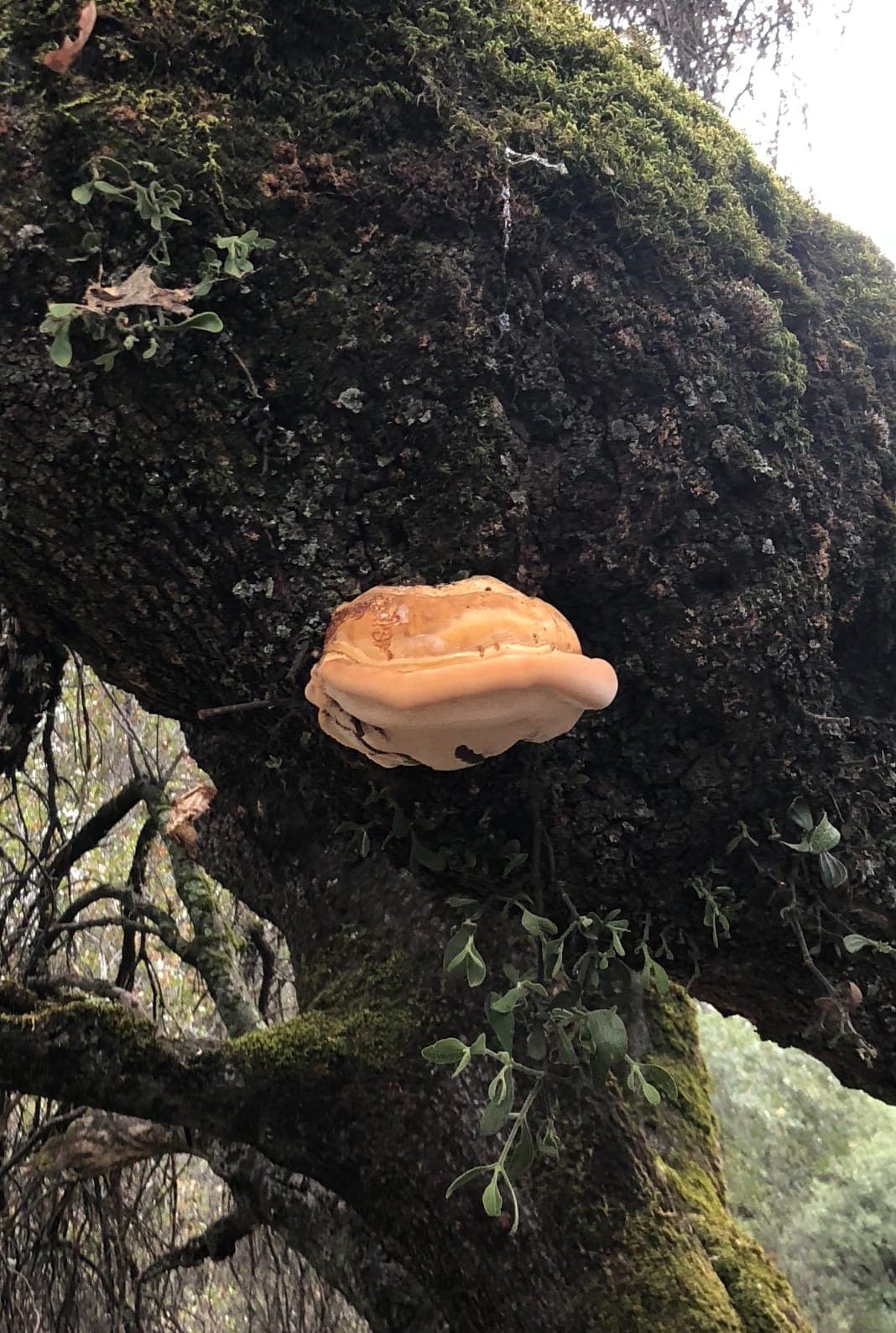
That is why my read on a mistletoe call always starts with the host rather than the parasite. A vigorous oak with three clumps and a healthy root zone has a cosmetic issue. A drought stressed oak carrying thirty, on compacted soil with summer irrigation problems, is being actively pushed downhill, and the mistletoe is one of the hands doing the pushing. The photograph at the top of this page makes the point for me: the same mossy oak limb carrying those mistletoe sprigs is also fruiting a conk of Inocutis dryophila, a heartwood decay fungus of oaks. Stresses stack on real trees, and the clump you can name is rarely the only thing at work.
How mistletoe is actually removed
Three methods have evidence behind them, and each comes with an honest limitation attached:
- Pruning the infected branch. The only true removal, because it takes the haustorial system out with the wood. The cut goes at least one foot below the visible attachment, since the strands extend inside the branch beyond what you can see, and it should fall back to a proper lateral or the branch collar. Right for heavily infected or already weakened branches; wrong as a whole tree strategy when it would strip the crown.
- Removing the shoots and wrapping the area in black plastic. Where the branch is too large or too important to sacrifice, the shoots are cut flush and the attachment zone is wrapped in a few layers of wide black polyethylene, tied or taped, to starve the resprouting shoots of light. It can take up to two years to exhaust the plant, the wrap needs checking for tears, and regrowth is still possible. Unglamorous, and it works.
- A plant growth regulator. Ethephon is registered for mistletoe shoot suppression, sprayed on the clumps in the dormant season. It can make shoots drop, and it is temporary: the haustorial system inside the branch survives, the mistletoe regrows, and retreatment is part of the deal. It is a management tool for high value trees, not a cure.
On the licensing line, stated plainly as always: I hold a California Qualified Applicator License and can apply a registered material such as ethephon where it is appropriate. I am not a Pest Control Adviser, and writing the material recommendation is the PCA's licensed function. And I perform no pruning, so where branch removal is the right call, my role is the assessment that says which branches justify the cut, which clumps can stay for the birds, and what the tree's water situation says about how urgent any of it is. That written plan is what a tree care company then executes, and it protects you from the crew whose answer to mistletoe is stripping the crown.
When to act, and when to leave it alone
- Leave it: a few clumps on a vigorous oak with a healthy root zone. Enjoy the phainopeplas.
- Manage it: rising counts on an oak showing stress, thinning, or a compromised root zone. Fix the water and soil first, then reduce the heaviest clumps by the methods above.
- Act promptly: heavily infected individual branches over targets, since mistletoe weakened wood fails, and any spreading dwarf mistletoe in pines you care about, where early branch removal can still change the outcome.
Sources
- UC IPM Pest Notes: MistletoeThe University of California reference behind the control methods above: the one foot pruning rule, the black polyethylene wrap, and ethephon's temporary effect.
- Glatzel and Geils (2009), Mistletoe ecophysiology: host parasite interactions, BotanyThe peer reviewed treatment of mistletoe water relations, including the open stomata behavior under host stress.
- USDA Forest Service Field Guide to Insects and Diseases of California OaksThe federal field guide covering the agents of California oaks, mistletoe included.
Frequently Asked Questions
Is mistletoe bad for trees?
It is a parasite, so it is never good for the tree, but the honest answer runs a range. A light load of broadleaf mistletoe on a healthy oak is a slow water tax the tree can usually carry for years. A heavy load on a drought stressed oak is a real contributor to decline, because the parasite keeps drawing water when the tree is trying to conserve it. And dwarf mistletoe in conifers is a genuinely serious disease that deforms, stunts, and kills.
How do you remove mistletoe from a tree?
Permanently, only one way: prune the infected branch at least a foot below the attachment, because the absorbing system lives inside the wood beyond the visible clump. Where the branch is worth keeping, the alternatives are cutting the shoots and wrapping the area in black plastic for up to two years to starve the regrowth of light, or suppressing shoots with the growth regulator ethephon on a repeating schedule. Simply breaking the clumps off is temporary by definition.
Does cutting mistletoe off kill it?
No. The visible plant grows from a haustorial system embedded inside the branch, and removing the shoots leaves that system alive. The mistletoe resprouts from within the wood, usually within a couple of seasons. That is not a reason to do nothing, since removing shoots before they fruit slows the spread, but it is the reason shoot removal alone never ends an infection.
Will mistletoe kill my oak?
By itself, rarely, and almost never quickly. What it does is weaken branches and tax the water budget, so it kills in partnership: with drought, with root damage, with compaction, with the other stresses this region supplies for free. An oak declining under a heavy mistletoe load usually has more than one problem, and sorting out how much is the parasite and how much is the site is exactly what an assessment is for.
What about the mistletoe in my pine trees?
Take that one more seriously. Conifer mistletoes are the dwarf mistletoes, a different genus with a different biology: nearly leafless, dependent on the host for carbon as well as water, systemic in the branch, and spread tree to tree by explosively launched seeds. Witches' brooms, dense distorted branch clusters, are the signature. Early removal of infected branches can still change the outcome, so a pine with brooms is worth an assessment sooner rather than later.
Should mistletoe be sprayed?
There is no spray that kills mistletoe outright without harming the tree. The registered option is ethephon, a plant growth regulator that makes shoots drop temporarily and requires retreatment as they regrow. It has a legitimate place on high value trees where pruning is undesirable. As a Qualified Applicator I can apply it where appropriate; the written recommendation of a material is a Pest Control Adviser's licensed function, and I will say so rather than blur that line.