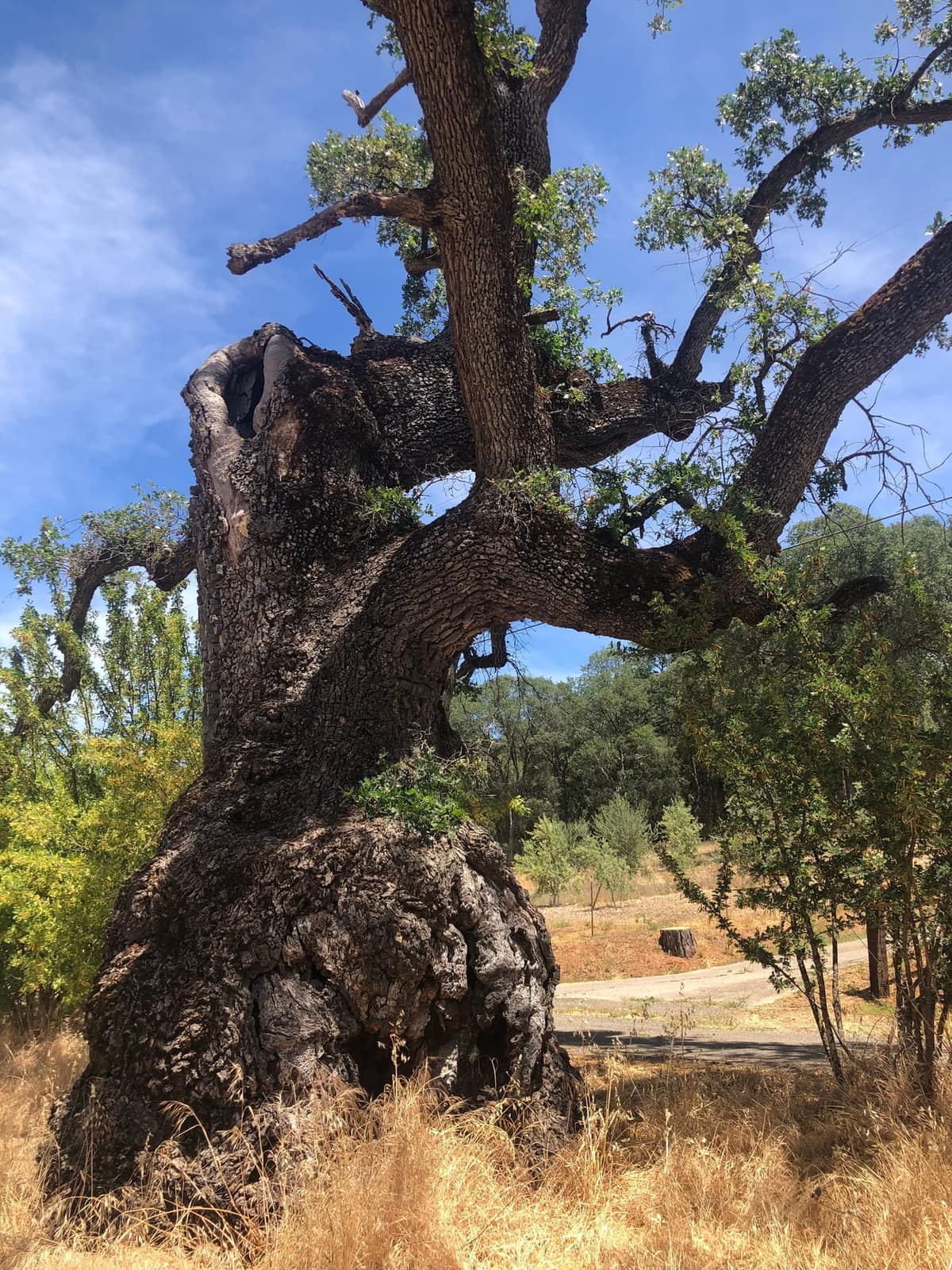
August is undoubtedly summer in California. The Central Valley and the Sierra foothills are routinely over 100 degrees Fahrenheit, and this is the time of year when shade is most beloved, and frequently essential, for wildlife and humans alike. But how do so many trees tolerate it? When asphalt in full sun is hot enough to fry an egg, how does a tree not boil from the inside out, sitting in that same sun all day long?
The physical defenses come first
Well, first there are physical protectants. Trees have developed glaucous leaves, hair like trichomes, and thick waxy cuticles, and some simply lose their leaves during the height of summer, the way our drought deciduous California buckeye, Aesculus californica, does. But many employ a far less visible biochemical mode of protection. They create isoprene, a volatile compound that diffuses through the leaf tissue and escapes into the atmosphere.
An expensive gas that earns its keep
Isoprene is not cheap for a tree to make. Producing a single molecule costs the leaf 20 ATP and 14 NADPH, and an emitting tree can spend around two percent of the carbon it fixes on this one compound. A tree does not carry a cost like that for nothing.
What it buys is protection for photosynthesis at exactly the moments summer is most dangerous. A leaf in the open does not sit at one temperature: as sun, cloud, and wind shift, leaf temperature swings through a range of more than 10 degrees centigrade over the course of a day, spiking fastest in the flecks of full sun. Isoprene helps the photosynthetic machinery ride out those heat spikes, and it reduces the oxidative stress that builds up in a leaf during high temperature episodes. Exactly how it manages this at the molecular level is, according to the literature, not fully settled. But its effects have been tested many times over, and they are real: isoprene is key to getting an emitting tree through its most stressful days.
Oaks are champions at it
Of note from the isoprene studies is that oaks emit more of it than most other tree genera. Every North American oak that has been measured emits isoprene, and in the surveys that measured California's landscape trees, the oaks sit high in the emission tables, our own California black oak, Quercus kelloggii, among the strong emitters. Imagine how different the interior of California would look without this biochemical heat defense. The oak savannas that define the foothills spend every summer being tested by exactly the conditions isoprene protects against.
What happens when the gas reaches the sky
While there is still much to learn about the mechanisms at play inside the tree, we know more about what happens once the gas escapes the leaves. Isoprene and its cousins, the volatilized terpenes, react in the atmosphere to form fine particles. Those particles scatter light, and they are credited with the famous blue haze of the Blue Ridge Mountains, an observation in the scientific record since 1960. The same particles can serve as seeds for water droplets, helping clouds form over forested country.
And here is where a popular talking point gets the chemistry backwards. Isoprene can participate in ozone formation, and advocates of industrial pollution have pointed at that fact to claim that nature pollutes too, that trees are bad for air quality, even that the answer is to cut them down. What that argument omits is the ingredient doing the damage. Isoprene only drives ozone production in air already rich in nitrogen oxides, which come overwhelmingly from combustion, from tailpipes and smokestacks. In clean air, the same chemistry can run the other way, and isoprene emission can reduce ozone. The smog ingredient is ours, not the tree's, and a healthy forest canopy pays ecological dividends, shade, habitat, cooling, carbon, that no honest accounting leaves out.
Sources
- Sharkey, Wiberley and Donohue (2008), Isoprene Emission from Plants: Why and How, Annals of BotanyThe open access review behind this piece: the energetic cost, the heat fleck protection, the oxidative stress evidence, and the NOx dependent ozone chemistry.
- Went (1960), Blue Hazes in the Atmosphere, NatureThe classic paper attributing the blue haze over vegetated country to volatile compounds released by plants.
- Karlik and Winer (2001), Measured isoprene emission rates of plants in California landscapes, Atmospheric EnvironmentMeasured emission rates for California landscape species, the state level context for the oaks' standing.