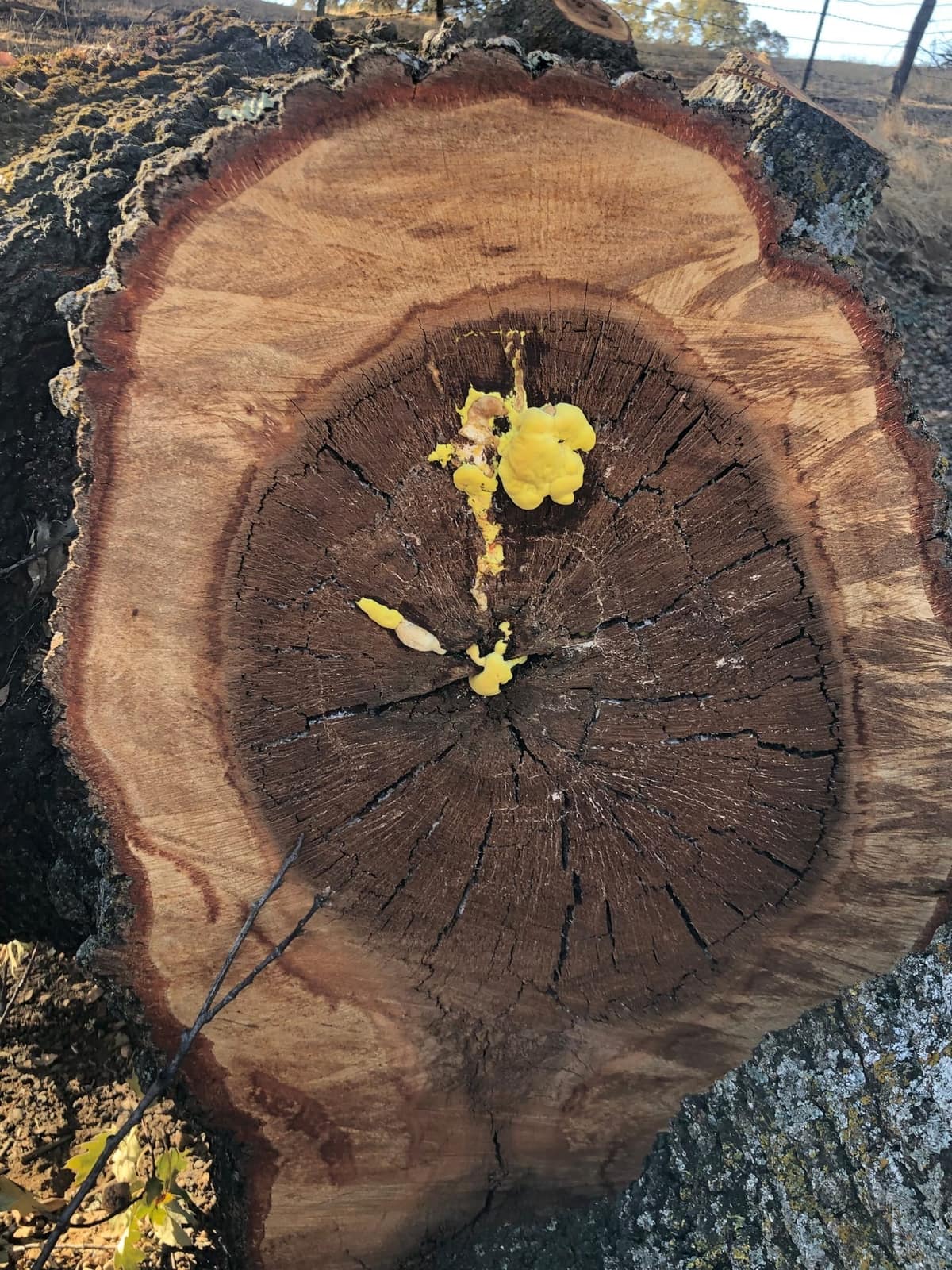
Here is the answer most pages will not give you: the majority of tree fungus cannot be treated with a spray, and no fungicide on a shelf will cure a tree that has wood decay. The fungus lives inside the wood, where nothing you apply to the outside reaches it, and the mushroom or conk you can see is the last stage of the process rather than the first.
That is not the whole story though. Some fungal diseases of trees genuinely are treatable, and treating them works well when the timing is right. The useful question is which kind you are dealing with, and that is a question of identification before it is a question of treatment.
The trees I see this on, and where
I work in the Sierra Nevada foothills, and the fungal problems that reach me track the species that grow here. On the oak side that is blue oak and interior live oak on the dry slopes above Placerville and Shingle Springs, valley oak on the deeper soils around Folsom and Sacramento, and California black oak through the middle elevations toward Camino and Pollock Pines. On the conifer side it is ponderosa pine, gray pine, sugar pine, incense cedar, and Douglas fir.
That matters because the same question has different answers on different hosts. Armillaria mellea at the root crown of a valley oak is a different prognosis from Heterobasidion in a ponderosa pine, and charcoal canker on a drought stressed blue oak is less a fungus problem than a water problem wearing a fungal mask. If you are reading this from a different climate and a different flora, the biology below still holds, but the species and the odds will not be yours.
The fungal problems that can be treated
These are mostly foliar and shoot diseases, the ones that live on or just inside the leaves and young twigs where a material can actually reach them:
- Peach leaf curl, which is treatable and is entirely about timing. It is managed during dormancy, before bud swell, and an application made after the leaves have distorted in spring accomplishes nothing at all that season.
- Anthracnose on sycamore, ash, and oak, where repeated defoliation is weakening the tree.
- Powdery mildew, shot hole, and the rusts, on ornamentals and fruit trees.
- Some canker pathogens, where the response is as much pruning and sanitation as anything applied.
For all of these, treatment is only half the job. The reason a tree is losing to a foliar pathogen year after year is usually the growing conditions, so correcting water, drainage, airflow, and mulch does more for the long run than repeating an application every spring.
The fungal problems that cannot
These are the ones people most often arrive hoping to spray, and they do not work that way:
- Wood decay fungi, the group that causes heart rot and butt rot. The fungus is already established in the wood, and there is no product that penetrates sound timber to reach it.
- Root diseases such as Armillaria and Phytophthora. These are managed culturally, through drainage, irrigation, and grade, rather than cured. There is no labeled treatment that eradicates Armillaria from a landscape tree.
- Vascular wilts, which move inside the water conducting tissue where surface applications do not follow.
Being told this early is worth money. The common sequence I get called into is someone who has spent two seasons and several hundred dollars treating the wrong category of problem, while the actual cause, usually a site or water issue, went on working uninterrupted the entire time.
So what does treatment look like when there is no spray?
It looks like management, and it is more effective than it sounds. For a tree with wood decay the work runs in this order:
- Identify the organism. Not the category, the organism. This decides everything that follows and it is the step most often skipped.
- Establish how much sound wood is left and where. Decay matters because of what it does to strength, so the question is structural as much as biological.
- Find and correct whatever let the fungus in. Decay fungi are opportunists, and most of them entered through a wound, a bad pruning cut, a buried root collar, or roots damaged during construction.
- Reduce what the tree has to carry, where that helps. Sometimes weight reduction buys a decade on a tree that would otherwise be removed.
- Set a monitoring interval, in writing, so change gets measured against a baseline rather than remembered.
- Remove it if the structure no longer justifies keeping it near a target. That is a real outcome and an honest report says so.
Why the name of the fungus changes the prognosis
This is the part that separates a real diagnosis from a guess, and it is the reason I identify organisms in the laboratory rather than from the outside of the bark. Decay fungi do not all attack wood the same way, and the type of decay changes how the tree is likely to fail.
Brown rot fungi consume the cellulose and hemicellulose and leave a modified lignin behind. The residual wood turns brittle and crumbles into cubes, and it tends to fail suddenly rather than bending first. White rot fungi degrade lignin along with the cellulose, and the wood left behind stays more fibrous and generally retains more ductility. Two trees with the same visible amount of decay can therefore carry very different amounts of risk depending on which organism is in there.
The same logic applies to whether a fungus is a pathogen at all. Some species on the list of things that fruit on a trunk are aggressive pathogens of living tissue, some only decay wood that has already died, and some are doing nothing to the tree whatsoever. Calling all of them tree fungus and reaching for the same product is how good trees get removed and bad trees get kept.
Heart rot, butt rot, and what a conk is telling you
Heart rot is decay of the inner wood of the trunk or a major limb. Butt rot is the same process at the base and in the buttress roots, and it is the more serious of the two, because that is where the loads are highest and where a failure takes the whole tree rather than a branch.
A conk is a fruiting body, and it is a late symptom. By the time a fungus has the resources to build a reproductive structure on the outside, it has been working through the wood inside for a considerable period. That is why a fresh crop of conks at the base of a mature tree deserves a proper assessment rather than a wait and see. It is also why the absence of conks proves very little; plenty of decayed trees have never fruited.
Is tree fungus dangerous?
To you, almost never. Tree decay fungi are not human pathogens and they do not spread to people or pets by being in the garden. The genuine caution is about eating them: several species that fruit on trees around here are toxic, including the jack o lantern that fruits at the base of oaks and is regularly mistaken for chanterelle. Never eat a wild mushroom on the strength of a photograph or an app.
To the tree, the danger is real but depends entirely on species, location, and extent. To your property, the danger is structural: a decayed tree within falling distance of a house, a driveway, or anywhere people gather is a risk question, and that is what a tree risk assessment answers.
How I identify what is on your tree
Where the fungus can be named in the field, I name it in the field. Where it cannot, I culture it. That means isolating the organism onto malt extract agar or potato dextrose agar, then examining the spore and hyphal structures under the microscope, using stains such as lactophenol cotton blue and Congo red where the structures need contrast. Fungal taxonomy is the part of arboriculture I have spent over fifteen years on, and it is why people bring me the trees nobody else could explain.
A site assessment with a written report starts at $500, and includes the identification, the evidence behind it, and a management plan. The site visit on its own is $250 and covers up to one hour. Where laboratory pathology is needed I will tell you the cost before that work begins. Where a treatment is appropriate and I can apply it, I hold a California Qualified Applicator License. I am not a Pest Control Adviser, so writing the material recommendation is not my licensed function, and I will tell you that rather than blur it.
I run no removal crew, so nothing in my findings is steering you toward a cut. Where a report does point to root or soil work that I can perform myself, I say so plainly in it. Call (530) 391-6100.
University and arboricultural sources
- UC IPM Pest Notes: Wood Decay Fungi in Landscape TreesThe California reference on decay fungi, what conks indicate, and why fungicides do not address them.
- USDA Forest Service: Stem Decay FungiFederal reference on the stem decay organisms and the decay types they produce.
- Tree Care Industry Association: Identifying Important Wood Decay SpeciesWhy species identification drives the structural interpretation of decay.
- UC IPM Pest Notes: Armillaria Root RotThe root disease with no labeled cure, and how it is managed culturally instead.
- UC IPM Pest Notes: Phytophthora Root and Crown RotThe other major root pathogen here, and why drainage and irrigation are the levers.
- North American Mycological Association, mushroom poisoning syndromesWhy no wild mushroom should be eaten on the strength of a photograph or an app.
Frequently Asked Questions
Can tree fungus be treated?
Some of it. Foliar and shoot diseases such as peach leaf curl, anthracnose, powdery mildew, and the rusts respond to treatment when it is applied at the right point in the season. Wood decay fungi, root diseases such as Armillaria and Phytophthora, and vascular wilts do not, because the organism sits where nothing applied to the outside can reach it. Which category you have is the first thing worth establishing.
Can tree fungus be removed?
Not in the way the phrase suggests. The visible conk or mushroom is only the fruiting body; the organism itself is distributed through the wood, and no amount of scraping, cutting the conk off, or sealing the spot removes it. What removal genuinely means in practice is pruning out an infected limb where the decay is confined to it, or removing the tree where the structure no longer justifies keeping it near a target. Between those two ends, the work is management: correcting what let the fungus in, reducing load, and monitoring. Anyone offering to remove the fungus itself from inside a living trunk is selling something that does not exist.
How do you treat fungus on a tree trunk?
Generally you do not, in the sense of applying something to it. A fungus fruiting on a trunk is a decay organism already inside the wood, and no product cures that. What you do instead is identify the species, work out how much sound wood is left and where, correct whatever let it in, reduce the load on the tree if that helps, and monitor it against a written baseline. Scraping the conk off changes nothing except your ability to track it.
Will a fungicide kill tree fungus?
Not for decay. A fungicide can protect foliage and new shoots from infection, which is why it works on the treatable diseases and why timing matters so much there. It does not penetrate sound wood to reach a decay fungus that is already established, and no product sold for garden use does.
Can a tree recover from a fungus?
From a foliar disease, usually yes, especially once the growing conditions behind it are corrected. From wood decay, the tree does not recover the wood it has already lost, because decayed wood is not replaced. Trees do compartmentalise, walling decay off and growing sound wood around it, and plenty live for decades in that state. The question stops being cure and becomes whether the remaining structure is adequate for where the tree is standing.
What is the difference between white rot and brown rot?
Brown rot fungi consume cellulose and leave modified lignin, so the remaining wood becomes brittle, crumbles into cubes, and tends to fail suddenly. White rot fungi degrade lignin as well as cellulose, and the wood generally stays more fibrous and keeps more of its ability to bend before breaking. It is one of the clearest reasons that identifying the organism matters for judging risk.
Does a tree with conks need to be removed?
Not automatically. It needs assessing. Conks mean established internal decay, but the decisions turn on which fungus, where on the tree, how much sound wood remains, and what is within falling distance. Some trees with visible conks are retained safely for years with monitoring. Others are genuinely finished. That is a judgement, not a rule.