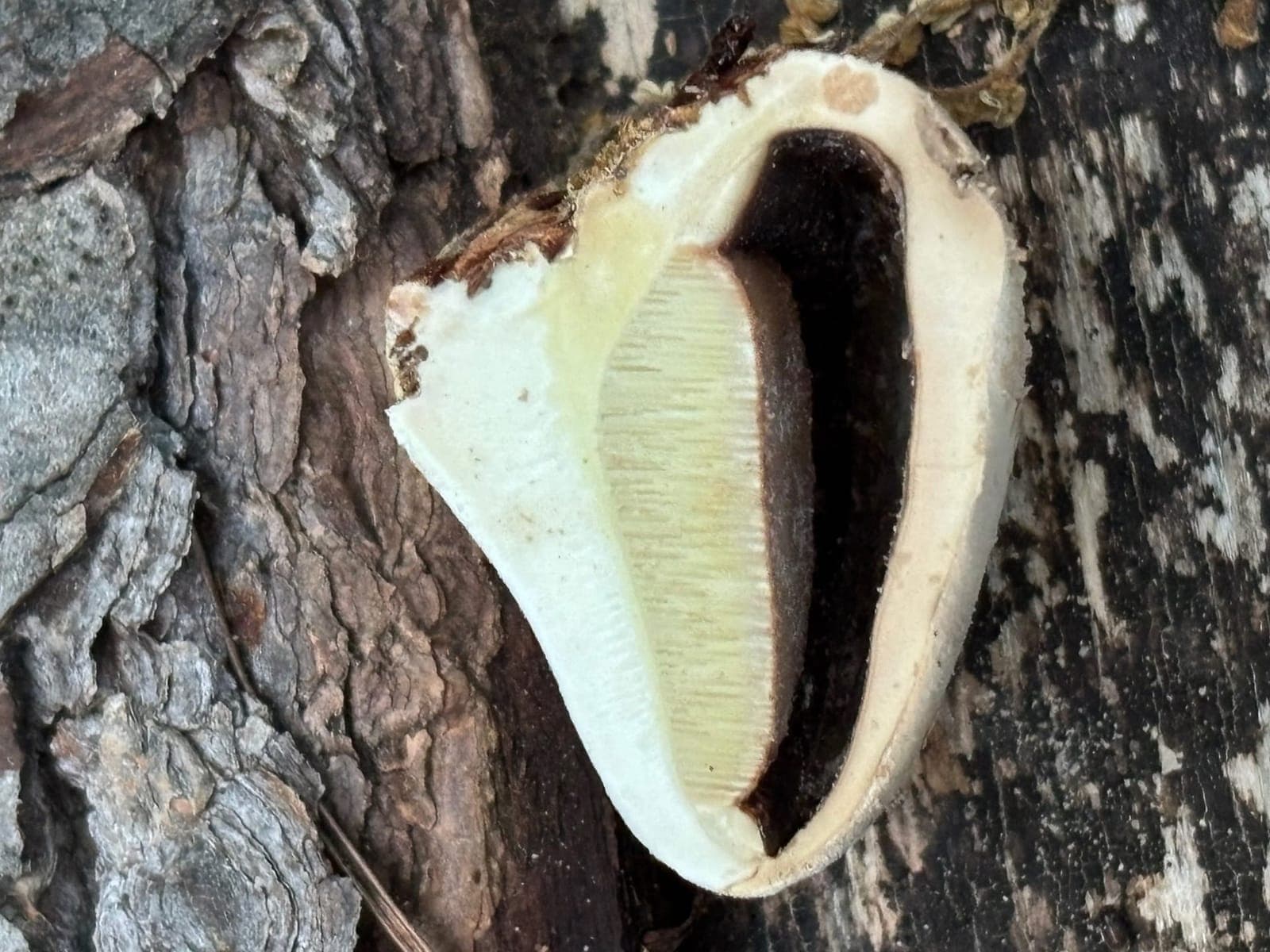
If you have walked a conifer forest with freshly dead trees, you have probably seen what look like roasted marshmallows stuck to the bark. That is Cryptoporus volvatus, the veiled polypore, a white to orange brown globe that fruits on recently dead and dying conifers. The genus name means hidden pores, and that is its signature: the fungus keeps its pale yellow pore surface sealed beneath a thin veil. For an arborist it is one of the most useful fungi to recognize, because where it appears it is usually telling you the tree is dead or nearly so, and that bark beetles have been at work. I am Christopher Hodge, an ISA Board Certified Master Arborist, and this is the short version of what this fungus is and why it matters in the field.
What the veiled polypore is
Cryptoporus volvatus causes a white rot in the sapwood of dead conifers and fruits on both standing dead trees and fallen wood. In California its common hosts are the firs (Abies), pines (Pinus), and Douglas fir (Pseudotsuga). It is found mainly across North America and East Asia. The feature that names it, the hidden pore surface, sits inside a small chamber under the veil, which is why you rarely see the pores until weather or insects break the membrane open.
The bark beetle connection
The early mycologists who described this species noticed two things that set it apart. Its fruiting bodies kept emerging from bark beetle bore holes in freshly killed trees, and beetles were found tunneling through the mushrooms themselves. That raised an obvious question. If the pore surface is sealed away, how do the spores get out? It led to the idea that the fungus and certain insects help each other.
It helps to separate the insects involved. Bark beetles in the subfamily Scolytinae, such as Dendroctonus and Scolytus species, are the ones that attack and kill the host tree, creating the dead wood that Cryptoporus then colonizes, and the polypore later fruits from the holes those beetles left behind. The insects found living inside the mushroom, though, are mostly fungus eating (mycophagous) beetles rather than wood eaters. A Japanese survey by Kadowaki examined hundreds of fruiting bodies and recovered nearly nine thousand insects across seventeen species, several of them specialists on this one fungus, and most of them fungus feeders. What ties the fungus to the tree killing beetles is that viable Cryptoporus has been cultured from beetles caught in flight, including the Douglas fir bark beetle and the fir engraver beetle, so at least some beetles do carry it to new trees.
The mystery of the veil
The veil itself is still debated. For a long time it was assumed to exist for insect dispersal, trapping spores in a chamber where beetles would pick them up. Harrington challenged that. By collecting airborne spores from fruiting bodies in the field over many weeks, he measured spore release that rivaled ordinary wind dispersed polypores, and argued the veil is mainly a defense against drying out in the low humidity of western conifer forests. The two ideas are not mutually exclusive. The veil may both protect the pores from desiccation and concentrate spores where insects gather them, and having more than one way to spread may be part of why this fungus is so widespread.
As for why it so often fruits from beetle holes, the simpler explanation may be that fungi need oxygen and an opening to fruit, and a bark beetle exit hole is frequently the only route a fruiting body has to reach the outside of the bark.
In my own service area, across El Dorado, Placer, and Amador counties, I find it on ponderosa and gray pine that western pine beetle or Ips have already killed, most often on the drier slopes around Placerville, Camino, and Pollock Pines. It is a reliable marker. Where the veiled polypore is fruiting, the beetles came first and the tree was already gone before the fungus arrived.
Why it matters for arborists
Cryptoporus volvatus is one of the easiest fungi to identify on conifers, and its presence is a reliable diagnostic sign. Because it colonizes dead sapwood and fruits from bark beetle holes, finding it on a standing tree is strong evidence the tree is already dead or in the final stage of decline. It is occasionally reported on living trees, but that is uncommon and usually means severe decline.
Just as important, the veiled polypore is a prompt to look wider. If I find it on a standing conifer, I check the neighboring trees of the same or similar species for the signs of an active bark beetle attack: pitch tubes on the trunk, reddish boring dust in the bark crevices, and fading or reddening crowns. The fungus is quietly telling you that bark beetles have been in the area and that the trees next door may already be under attack. That is the kind of observation that turns a single dead tree into a stand level assessment.
Frequently Asked Questions
What is the white or orange fungus that looks like a marshmallow on my pine?
It is most likely Cryptoporus volvatus, the veiled polypore. It fruits as a smooth white to orange brown globe on recently dead and dying conifers, especially pines, firs, and Douglas fir. It grows on wood that is already dead, so on a standing tree it usually means the tree has died or is nearly gone.
Does the veiled polypore kill trees?
No. Cryptoporus volvatus is a decay fungus of wood that is already dead, and it does not kill living trees. What it signals matters more than what it does: it colonizes trees that bark beetles have already killed, so its presence points you toward bark beetle activity in the surrounding stand.
I found it on a standing tree. What should I do?
Treat it as a flag to assess the wider area. The tree it is fruiting on is very likely dead, and a dead conifer near a home or target may need to come down for safety. Then look at the neighbors for pitch tubes, boring dust, and crown fade, because the beetles that created this dead tree may be moving on to the next ones. A consulting arborist can sort out which trees are hazards and which are still defensible. Call or text (530) 391-6100.
Sources
- Borden, J.H., and McClaren, C.G. (1970). Biology of Cryptoporus volvatus in southwestern British Columbia: distribution, host species, and relationship with subcortical insects. Syesis, vol. 3.
- Harrington, T.C. (1980). Release of airborne basidiospores from the pouch fungus, Cryptoporus volvatus. Mycologia, vol. 72(5).
- Kadowaki, K. (2010). Species coexistence patterns in a mycophagous insect community inhabiting the wood decaying bracket fungus Cryptoporus volvatus. European Journal of Entomology, vol. 107(1).
- Park, M.S., and colleagues (2014). Coleopteran insects associated with spore dispersal of Cryptoporus volvatus in Korea. Journal of Asia Pacific Entomology, vol. 17.
- Mallams, K.M., Chadwick, K.L., and Angwin, P.A. (2010). Decays of white, grand and red firs. Forest Insect and Disease Leaflet 52. USDA Forest Service.
- Six, D.L., and colleagues (2026). From beginning to end: the synecology of tree killing bark beetles, fungi, and trees. Biological Reviews, vol. 101(1).
- Nwankwegu, A.S., and colleagues (2025). Exploring the critical environmental optima and biotechnological prospects of fungal fruiting bodies. Microbial Biotechnology, vol. 18(8).