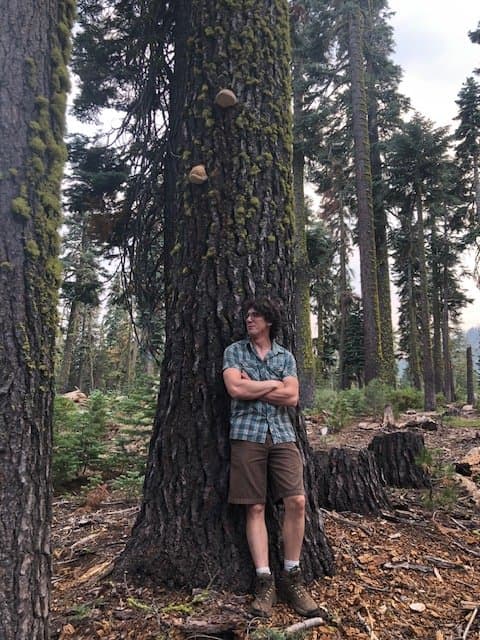
A tree health assessment is a systematic inspection of a tree by a qualified arborist, done to find out why the tree is struggling and what can be done about it. It is diagnosis, not guesswork. I examine the whole tree from the roots to the crown, along with the site around it, and deliver a written finding of what is wrong and a plan to address it. If you have a tree that is thinning, dropping leaves, growing mushrooms, browning out of season, or simply not looking right, this is the service that tells you what is actually going on.
Signs your tree needs a health assessment
A tree rarely fails all at once. It sends signals first, and the earlier they are read, the more options you have. Common warning signs include:
- Canopy dieback that starts at the top of the tree or the branch tips and works inward.
- Leaves that are undersized, off color, yellowing or browning out of season, or noticeably sparse.
- Premature leaf drop, or a canopy that leafs out late or unevenly in spring.
- Deadwood and dying branches scattered through an otherwise living crown.
- Dark bleeding, oozing, sunken cankers, or cracked and peeling bark on the trunk or limbs.
- Mushrooms or hard shelf conks at the base, on the roots, or on the trunk, which can point to internal decay or a root disease.
- Needles turning yellow, red, or brown on a pine or fir, whether scattered through the crown or all at once.
- Popcorn sized blobs of pitch on the trunk, or fine reddish boring dust collecting in the bark crevices and at the base of the tree.
- Bark falling away in plates, often with pale patches where woodpeckers have been working the trunk for larvae underneath.
- A tree that has gone downhill quickly after nearby construction, grading, trenching, or a change in irrigation.
Most tree decline is about the site, not a bug
The most common mistake I see is reaching for a spray before anyone has asked why the tree is stressed. According to the University of California Statewide Integrated Pest Management Program, most disorders affecting landscape trees are abiotic, meaning they are caused by non living factors such as drought, overwatering, buried root collars, soil compaction, planting too deep, or mechanical injury, rather than by an insect or a disease. Those stresses come first, and the pests and pathogens follow. A drought stressed tree cannot close its wounds quickly or push out enough resin to repel an attack, which is exactly when bark beetles and canker fungi move in. So a real health assessment starts with the growing conditions, then works up to the living pests, not the other way around.
This matters commercially as well as biologically. If the true cause is a sprinkler running against the trunk or a grade change that buried the root collar, then a treatment aimed at the insect you can see will fail, and you will have paid for it. Getting the order right is most of the value of an independent inspection.
How I inspect a declining tree
I work from the ground up, because most serious tree problems begin below eye level. The inspection follows the same sequence every time, so that nothing gets skipped because something more obvious caught the eye first:
- The site and soil: drainage, grade changes, recent construction, irrigation placement and timing, and how much usable root space the tree actually has.
- The root collar and root zone: I check for a buried or girdling root collar, root disease such as Armillaria, and damage from trenching or compaction. Where the flare is buried I will often need to excavate to see what is happening.
- The trunk and scaffold branches: cankers, bleeding, decay, cavities, cracks, and old wounds.
- The canopy: dieback pattern, foliage color and density, and shoot growth over recent seasons. The shape of the dieback frequently names the problem on its own, because root trouble, vascular trouble, and insect attack each thin a crown differently.
- Laboratory diagnosis when it is needed: for a fungal or pathogen question I identify the organism under the microscope rather than guessing from the outside, which is the part of this work I specialize in.
Ruling causes out matters as much as finding them. A written finding that says what the problem is not, and why, is what makes the remaining diagnosis worth acting on.
Laboratory identification and tree health testing
Most tree problems can be settled in the field. Some cannot, and that is where a lot of tree care goes wrong, because a guess made from the outside of the bark gets treated as a diagnosis. When the question is which fungus is present, I culture and identify it rather than reading the symptoms and hoping.
That means isolating the organism onto malt extract agar or potato dextrose agar, then examining spore and hyphal structures under the microscope, using stains such as lactophenol cotton blue and Congo red where the structures need contrast. Identification changes the answer. Several wood decay fungi look alike on the outside of a trunk while differing completely in how fast they compromise the wood and whether the tree can be retained. Fungal taxonomy is what I have spent over fifteen years studying, and it is the reason people call me for the trees that are hardest to explain.
What a tree health assessment costs
A site assessment with a written report starts at $500. That covers the inspection, the diagnosis, the evidence behind it, and a plant health care plan you can act on. If you want a professional opinion on site without a written report, the site visit on its own is $250 and covers up to one hour on site. Where a situation calls for laboratory pathology or a longer report, I will tell you the cost before any additional work begins.
Set that against the alternative purchase. Removal of a medium sized tree near a house commonly runs $1,500 to $4,000, and it is the one option you cannot undo. Most of what I get called about turns out to be abiotic, a watering pattern, a grade change, a compacted root zone, and correcting the cause costs far less than replacing a mature canopy tree and waiting thirty years to get the shade back.
Tree doctor, tree health assessment, or tree inspection?
Most people who call me use a simpler phrase than the one at the top of this page. They ask for a tree doctor. It is not a formal title and no board issues it, but it describes the work accurately: somebody who diagnoses a sick tree, explains what is actually wrong with it, and says what to do next. That is this service.
Whether you call it a tree doctor, a tree health inspection, a tree health assessment, or a tree health evaluation, most callers mean the same thing: have somebody qualified look at the tree and tell me what is going on. That is what this service is, whichever phrase you arrived with.
Where the words do pull apart is in what gets produced at the end. A tree inspection can be a look and a verbal answer. A tree health assessment, as I deliver it, is the inspection plus a written diagnosis with the evidence behind it and a plan. If a lender, an insurer, a neighbor, an HOA, or a court is going to read the result, you want the written version, because a verbal opinion is not something anyone can rely on later.
One difference is worth knowing before you call anybody. Plenty of removal companies advertise as tree doctors, and some of them are genuinely good at removal. The difference shows up when the answer is not removal. I am an ISA Board Certified Master Arborist, I do not run a removal crew, and I have no financial stake in whether a tree comes down. If a tree doctor's recommendation always seems to end in a chainsaw quote, that is worth noticing.
Tree health assessment or tree risk assessment?
These answer two different questions. A tree health assessment asks whether a tree is biologically healthy and what is making it decline. A tree risk assessment asks whether a tree is likely to fail and hit something, and how serious that would be. They overlap, because a sick tree is often a structurally weaker one, and I frequently do both on the same visit. But if your main concern is a limb over the house or a leaning trunk, start with a tree risk assessment, which has its own page. If it is a tree that looks unwell and you want it to recover, start here.
Pines, firs, and conifer decline
Conifer decline in the foothills follows a pattern worth knowing, because the window to act on it is short. Drought or root stress weakens the tree, its resin defense drops, and bark beetles that the tree would ordinarily push out succeed instead. UC IPM counts roughly 200 bark beetle species in California. The ones that matter locally are the western pine beetle and Jeffrey pine beetle on pines, engraver beetles in the tops and in slash, and the fir engraver, Scolytus ventralis, on white fir.
The honest part first. Once beetles are established under the bark and the needles have gone red, the tree is not coming back, and no treatment changes that. What the assessment is really deciding at that point is the trees around it: which neighbors are already stressed, whether the stress is correctable, and whether a preventative treatment on high value specimens is worth doing before the next flight. I hold a California Qualified Applicator License and can apply control materials where they are appropriate. I am not a Pest Control Adviser, so the written material recommendation is not mine to make, and I will say so rather than blur it.
The signs to call about are pitch tubes on the trunk, reddish boring dust in the bark crevices, sudden fading of the whole crown from green to yellow to red, and woodpecker work stripping patches of bark. Fading that starts at the top and works down usually points somewhere different from fading that starts at the bottom, which is one of the things a proper inspection sorts out.
Oaks and hardwood decline
Oaks decline on a slower clock than conifers, which cuts both ways: there is more time to intervene, and the trouble is much further along by the time it is obvious. Summer irrigation against the trunk of a native oak, a buried root collar, and construction damage in the root zone cause more oak loss around here than any pathogen does. Where a pathogen is involved, identifying which one is the whole job, and that is a longer subject that I have written up separately for the oaks of this region.
What you get
Every assessment includes a written report you can act on: the diagnosis, the evidence behind it, and a plant health care plan with clear next steps, whether that is a change in irrigation, soil or root collar work, targeted treatment, monitoring, or in some cases removal. Because I am an independent consulting arborist and do not run a removal crew, the plan is built around what is best for the tree and your property, not around selling you a cut.
When the assessment identifies work I can do
I now perform root and soil work myself: root collar excavation, root pruning, soil decompaction, and amendment. So an assessment sometimes points to a job I can carry out. Where that happens I say so plainly in the report, so you can weigh the finding knowing I have an interest in the remedy, and you are free to take the report to anyone you like. I do no pruning and no removal at all, which means nothing in my findings is quietly steering you toward a cut.
Where I do tree health assessments
I work out of Placerville and cover El Dorado, Sacramento, Placer, and Amador counties. That includes Placerville, Cameron Park, Shingle Springs, El Dorado Hills, Folsom, Rocklin, Roseville, Granite Bay, Auburn, and the communities around them. If you have been typing tree doctor near me or tree health assessment near me into a search bar, anywhere in the Sierra foothills or the greater Sacramento area, that is the ground I cover. Call (530) 391-6100 and tell me what the tree is doing.
University resources on tree health and diagnosis
- UC IPM: Landscape Tree Damage, It Is Not Always a Pest IssueThe University of California extension article behind the point that most tree disorders are abiotic.
- UC IPM: Diagnosing the Causes of Unhealthy PlantsThe diagnostic sequence UC teaches, working from site and culture toward biotic causes.
- ISA Arboriculture and Urban Forestry: The Diagnosis of Urban Tree DisordersThe arboricultural literature on how tree disorder diagnosis is structured.
- UC IPM: Bark BeetlesThe California reference on bark beetles, including the pine and fir species discussed above.
- UC IPM Pest Notes: Wood Decay Fungi in Landscape TreesWhat conks and mushrooms on a trunk actually indicate about the wood inside.
- UC ANR: Oaks in the Urban Landscape, Biotic and Abiotic DisordersCostello and colleagues on the disorders of oaks in built landscapes.
- University of Minnesota: Stem Girdling Roots, The Underground Epidemic Killing Our TreesWhy a buried root collar and girdling roots kill trees slowly and invisibly.
- ISA, Why Hire an ArboristThe International Society of Arboriculture on what a qualified arborist is for.
Frequently Asked Questions
Is a tree doctor the same as an arborist?
Close, but not identical. Tree doctor is an informal phrase and anyone is free to use it. Arborist is a profession, and ISA Board Certified Master Arborist is its highest credential, requiring examination, experience, and continuing education, and it can be checked in a public register. If you are hiring somebody to diagnose a tree rather than to cut one down, ask which they actually hold. Mine is WE-14385B.
How much does a tree doctor cost?
For my work a site assessment with a written diagnosis and a plant health care plan starts at $500. That is the same service whether you call it a tree doctor visit or a tree health assessment. Removal companies often offer a free estimate instead, which is a sales visit rather than a diagnosis, and it is priced accordingly.
What is a tree health assessment?
It is a systematic inspection of a tree by a qualified arborist to find out why it is declining and what can be done. It covers the site, the roots, the trunk, and the canopy, and where needed it includes laboratory identification of a fungus or pathogen. The result is a written diagnosis and a care plan.
How much does a tree health assessment cost?
A site assessment with a written report, including the diagnosis and a plant health care plan, starts at $500. The site visit on its own is $250 and covers up to one hour on site. If the situation calls for laboratory pathology or a more involved report, I will tell you the cost before any additional work.
How long does a tree health assessment take?
A single tree on an ordinary residential lot is usually an hour or less on site. Multiple trees, a large property, or a case that needs root collar excavation takes longer. The written report normally follows within a few business days, and if laboratory culture is involved it takes longer, because the organism has to grow before it can be identified.
What is in the written report?
The findings from the inspection, the diagnosis, the evidence and reasoning that support it, photographs, and a plant health care plan with specific next steps. Where a laboratory identification was made, the report names the organism and how it was identified. It is written to be read by somebody other than you, which matters when it is going to a lender, an insurer, an HOA, or a neighbor.
How is it different from a tree risk assessment?
A health assessment asks whether the tree is biologically healthy and why it is struggling. A risk assessment asks how likely the tree is to fail and what it could hit. They overlap, and I often do both in one visit, but they answer different questions.
Can a stressed tree recover?
Often, yes, if the cause is caught early and corrected. A mildly stressed tree can decline within one or two growing seasons if it is ignored, but many trees rebound once the underlying problem, usually a site or water issue, is fixed. Some conditions, such as advanced root disease, cannot be reversed, and an honest assessment will tell you which case you are in.
What causes most tree decline?
Most of it is abiotic, meaning non living site stress: drought, overwatering, a buried root collar, compacted soil, or root damage from construction. Insects and diseases are often secondary, moving in after the tree is already weakened. That is why a good assessment starts with the growing conditions.
Why are my pine needles turning brown?
On a foothill pine the usual sequence is water stress followed by bark beetles. Look for popcorn sized pitch tubes on the trunk and fine reddish boring dust in the bark crevices. Browning that comes on fast across the whole crown is a different problem from browning confined to the inner and lower needles, which is often just normal seasonal needle shed. An inspection tells you which one you are looking at, and whether the trees nearby can still be protected.
Can you tell what is wrong from a photo?
Sometimes I can narrow it down, and I am happy to look. But a photograph shows the canopy and almost never shows the root collar, the soil, the irrigation, or the grade, which is where the answer usually is. I will tell you honestly if a photo is enough, rather than booking a visit you do not need.
Do you inspect trees before a home purchase?
Yes. Mature trees are one of the few things on a property that can carry a four or five figure liability and are not covered by a standard home inspection. A pre purchase tree inspection tells you what you are taking on before you own it.