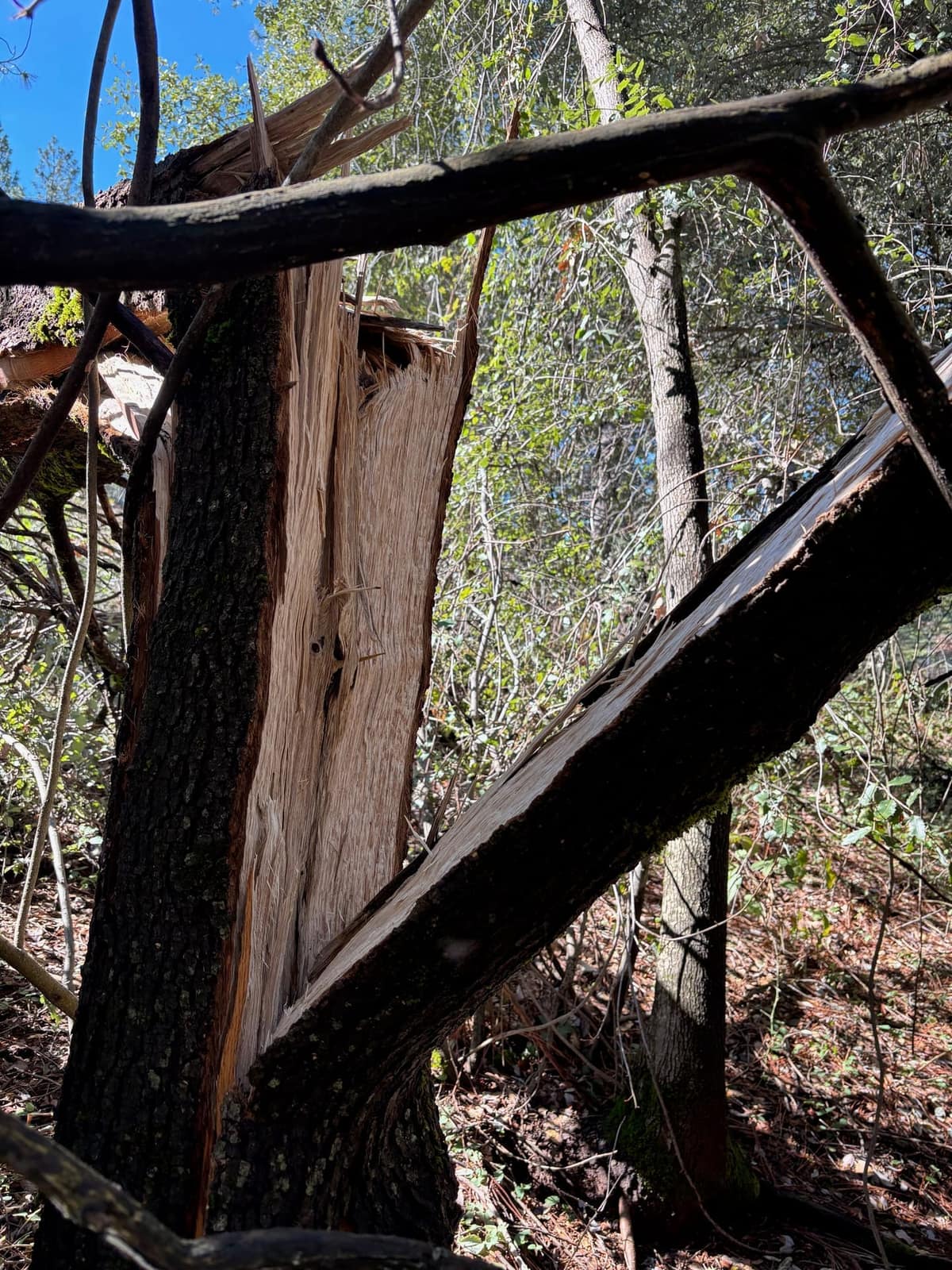
A tree risk assessment is a systematic evaluation of whether a tree is likely to fail, what it would hit if it did, and how bad that would be. A tree that looks healthy can still fail: decay, structural defects, and root problems are often invisible until it is too late, and the opposite mistake is just as expensive, a sound tree removed because somebody with a chainsaw called it dangerous. I am TRAQ qualified, I run no removal crews, and my findings go in writing.
A tree risk assessment evaluates three things:
- The likelihood that a tree or part of a tree will fail
- The likelihood that failure would strike a target (person, structure, vehicle)
- The consequences of that failure
The result is a risk rating, Low, Moderate, High, or Extreme, along with written findings and recommended actions. Risk lives in the combination, which is why the same defect can rate differently over a lawn than over a bedroom: a heavily decayed tree over an empty pasture can be lower risk than a mildly defective one over a playground.
When people call for one
- A large or aging tree near the house, and a nagging feeling about it
- An insurance company requiring documentation before issuing or renewing a policy
- A tree service said it needs to come down, and you want an independent opinion before spending the money
- After a storm, when a tree has shifted, cracked, or dropped a limb
- After a fire, when scorched trees need sorting into survivors and hazards
- Buying or selling a property with mature trees, especially during escrow
- HOAs and property managers with trees over pathways, parking, and amenities
- Attorneys and adjusters who need a defensible written finding for a dispute or claim
What the inspection reads
Every tree risk assessment I perform includes a Level 2 basic assessment, the standard of care for residential and commercial trees, covering:
- Ground level inspection of roots, root crown, trunk, scaffold limbs, and canopy
- Structural defects: cracks, cavities, codominant stems, included bark, deadwood, and decay
- Fungal fruiting bodies, and identification of the organism where one is present
- Target assessment: who or what is in the zone of failure, and how often
- Site conditions: slope, soil, drainage, recent construction, utilities, and exposure
- Species specific failure patterns, because a valley oak and a ponderosa do not fail the same way
Where the mycology changes the answer
This is the part of risk work where my practice differs from most. A conk on a trunk tells a generalist that decay is present. Identifying the organism tells you what kind of decay, and that changes the risk read directly: brown rot fungi consume the cellulose and leave wood that is brittle and fails suddenly, while white rot fungi leave wood that keeps more of its ability to bend before breaking. Two trees with the same visible extent of decay can carry genuinely different risk depending on which fungus is inside, and where the answer is not certain in the field, I culture and identify it in the laboratory. Fungal identification is the part of arboriculture I have spent over fifteen years on, and it is the reason my risk findings on decayed trees rest on more than a sounding mallet.
Mitigation is a ladder, not a switch
A risk finding is not a removal order. Depending on what the assessment finds, the options run from doing nothing, through pruning to reduce load or end weight, cabling and bracing, moving the target where that is possible, a monitoring interval with a written baseline, and only at the end of the ladder, removal. Because I do not perform pruning or removal, nothing in my recommendation earns me the work, which is precisely what makes the report useful to an insurer, a board, or a court.
TRAQ, and what qualified actually means
TRAQ is the ISA's Tree Risk Assessment Qualification, the credentialing program for arborists who conduct formal risk assessments. It standardizes the method: the same likelihood and consequence framework, the same three assessment levels, Level 1 limited visual, Level 2 basic, Level 3 advanced, and the same documentation, whoever holds it. Hiring a TRAQ qualified assessor means the finding is built on a defensible, recognized methodology rather than an opinion, which is what insurers, agencies, and attorneys are actually asking for when they require an assessment. I hold TRAQ on top of the ISA's Board Certified Master Arborist credential, and both are verifiable in the ISA's public directory through my credentials page.
What you receive
A written report with photographs, the risk rating for each assessed tree, the findings behind it, and specific recommended actions with their alternatives. It is written to be read by someone other than you, because these reports routinely go to insurers, HOA boards, county reviewers, and opposing counsel. A tree risk assessment with the written report starts at $500 and rises with the number of trees and the complexity of the site. The site visit on its own is $250 and covers up to one hour.
Tree risk assessment or tree health assessment?
They answer different questions. A risk assessment asks whether the tree is likely to fail and what it would hit. A health assessment asks why a tree is declining and whether it can recover. They overlap, because a sick tree is often a structurally weaker one, and I frequently do both in one visit. If your concern is a limb over the house or a lean that changed, start here. If the tree simply looks unwell, start with the health assessment.
Service area
I provide tree risk assessments throughout El Dorado County including Placerville, El Dorado Hills, Cameron Park, and Shingle Springs, plus Folsom, Sacramento County, and Placer County communities including Roseville, Rocklin, Granite Bay, and Auburn. Call or text (530) 391-6100.
Standards and references
- ISA Tree Risk Assessment QualificationThe ISA's description of the TRAQ credential and the standardized method behind it.
- ISA, Managing Tree Hazards and RisksThe ISA's owner guidance on recognizing and managing tree risk.
- UC ANR: Oaks in the Urban Landscape, Structural Failures, Defects, and Risk AssessmentCostello and colleagues on how oaks fail structurally and how that risk is assessed.
- UC IPM Pest Notes: Wood Decay Fungi in Landscape TreesWhat fruiting bodies indicate about the wood inside, the link between decay and structural risk.
Frequently Asked Questions
What is a tree risk assessment?
A systematic evaluation, by a qualified arborist, of the likelihood a tree or part of a tree will fail, the likelihood the failure would strike something that matters, and the consequences if it did. The product is a written risk rating with findings and recommended actions, prepared under the ISA's standardized TRAQ methodology.
How much does a tree risk assessment cost?
It is worth putting the fee next to the decision it informs. A tree service asked to look at a tree it could also remove has a $1,500 to $4,000 incentive to reach one conclusion. A tree risk assessment with a written report starts at $500, and rises with the number of trees and the complexity of the site. The site visit on its own is $250 and covers up to one hour on site.
What are the levels of tree risk assessment?
The ISA Tree Risk Assessment Qualification recognizes three levels: Level 1 limited visual, typically a drive by or walk by of many trees; Level 2 basic, a ground based inspection of the whole tree and site, which is the standard of care for most residential and commercial assessments; and Level 3 advanced, which adds tools such as decay testing or aerial inspection when the basic assessment finds something that justifies it.
Are you a certified arborist for tree risk assessments?
Yes, at the ISA's highest level. I am a Board Certified Master Arborist, WE-14385B, and I hold the ISA Tree Risk Assessment Qualification. Both are verifiable in the ISA's public credential directory.
Will you tell me to remove the tree?
Not unless the evidence supports it. As an independent consulting arborist with no removal crews, I have no financial stake in the outcome. Many assessments end in pruning, monitoring, or moving a target rather than removal, and when removal genuinely is the answer, you will have an independent written finding that says exactly why.
Do insurers and agencies accept your reports?
The reports are written to the ISA's standardized methodology, with the rating, the findings, and the reasoning documented, which is what insurers, HOAs, and public agencies are asking for when they require an assessment. That standardization, plus independence from any removal work, is the point of hiring a TRAQ qualified assessor rather than a tree service.