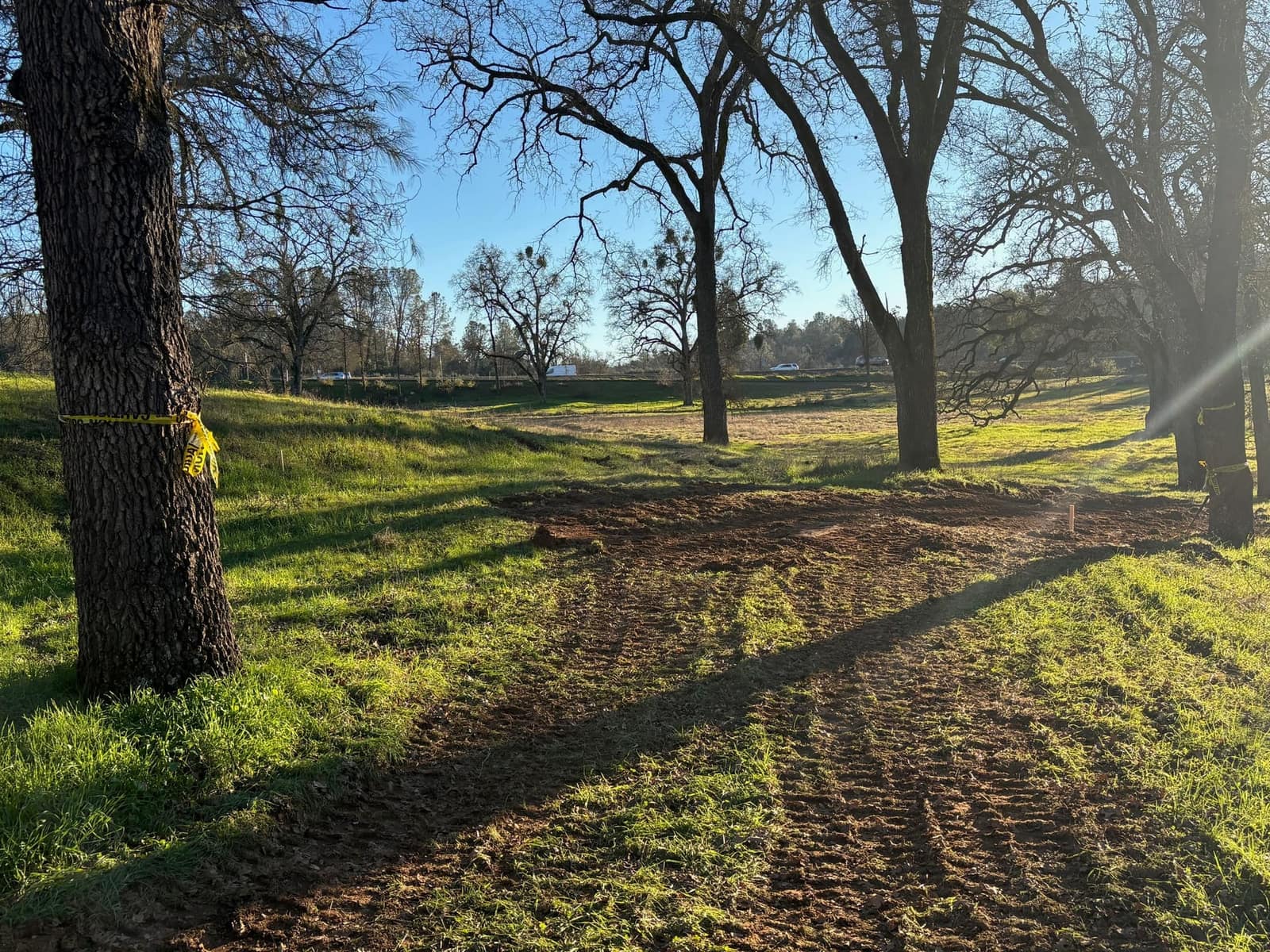
Cameron Park sits on two lines at once. It is unincorporated El Dorado County, so the county oak ordinance governs every protected tree here rather than any city code, and it straddles the boundary between state and local fire responsibility, so the statute controlling clearance around a house changes from one street to the next. I am Christopher Hodge, an ISA Board Certified Master Arborist. I write the oak reports the county asks for, and I run no removal crews, so nothing in my report is a bid for pruning or removal. If it points to root or soil work I can do myself, it says so.
The ordinance changed in July 2025
If you are reading advice that cites Ordinance 5061, it is out of date. Chapter 130.39 of the county zoning ordinance, the Oak Resources Conservation chapter, was amended in its entirety by Ordinance 5235 on July 22, 2025. It implements the county's Oak Resources Management Plan and covers privately owned land in the unincorporated county at or below 4,000 feet elevation wherever oak resources are present. It reaches ministerial permits, meaning an ordinary building or grading permit, as well as discretionary projects. That last point surprises owners who assumed a routine permit fell outside its scope.
What the county counts as a protected oak
Diameter is measured at four feet six inches above natural grade on the uphill side, which matters on sloped ground because the same oak measures differently from below.
- A single trunk native oak of 6 inches diameter or more, and less than 36 inches, is an individual native oak tree.
- A multiple trunk oak counts once the three largest stems combined exceed 10 inches.
- At 36 inches, single trunk or as the sum of the three largest, the tree becomes a heritage tree with heavier mitigation.
- Blue oak, valley oak, black oak, interior live oak, canyon live oak, Oregon oak, oracle oak and their hybrids are all named.
The tree protection zone is the greater of one foot of radius per inch of trunk diameter, or the whole ground area beneath the canopy. On a broad spreading oak that is usually the canopy, and it is routinely larger than the fence line a contractor planned for.
Permits, and who may write the report
Impacts to less than two acres of oak woodland go through an oak tree removal permit. Two acres or more requires an oak woodland removal permit. Both are administrative permits, and both applications require an Oak Resources Technical Report from a qualified professional, plus a code compliance certificate confirming no oak resources were impacted on the property in the prior two years. Earlier unpermitted clearing tends to surface at that step.
Fire clearance, and an exemption narrower than it looks
Maintaining defensible space under Public Resources Code section 4291 or County Code Chapter 8.09 is exempt from the oak permit requirement, as is work under an approved fire safe plan. The trap sits in the next line of the code: oak impacts for the initial establishment of defensible space on new development are not exempt. Clearing to create clearance for a house that does not exist yet is regulated. Keeping clearance you already have is not. This is also a true boundary community, with both state and local responsibility area parcels and very high hazard mapped in each, so one address answers to section 4291 and another to Government Code section 51182.
What an unpermitted removal costs
The in lieu fees adopted with the Oak Resources Management Plan are $153.00 per inch of diameter removed for an individual native oak, $459.00 per inch for a heritage tree, and $8,285 per acre of oak woodland. Removing without a permit brings fines on top: up to three times the in lieu fee for woodland, up to three times the market value of the replacement trees for an individual oak, and up to nine times that value for a heritage tree. The procedural penalty hurts longer. Every development application on that property is deemed incomplete until a settlement agreement is executed or enforcement concludes.
To the county, mistletoe does not make an oak diseased
The county has answered this one directly. An oak carrying broadleaf mistletoe is not automatically a diseased tree. If mistletoe is the reason for a proposed removal, the county wants written justification from a Certified Arborist or a Registered Professional Forester explaining why corrective work such as pruning the infestation out is not feasible.
What I do in the area
- Oak Technical Reports for county building and grading permits
- Support through the oak tree and oak woodland removal permit process
- Tree risk assessment for oaks over houses, driveways and outbuildings
- Diagnosis of oak decline, decay fungi and root disease
- Written justification letters for mistletoe, decline and hazard claims
Book a site assessment
A site assessment with a written report starts at $500. The site visit on its own is $250 and covers up to one hour on site. If a grading permit near oaks is coming, the cheapest hour you will spend is the one before the site plan is final, while moving a driveway ten feet is still free. Call or text (530) 391-6100.
Book a consultationFrequently Asked Questions
Does the county oak ordinance apply to my lot in Cameron Park?
If the parcel is privately owned, in the unincorporated county, at or below 4,000 feet elevation, and has oak resources on it, then yes. Chapter 130.39 is a county zoning ordinance, and there is no separate city code here because the community is unincorporated. It applies to ordinary building and grading permits, not only to discretionary projects.
Who is qualified to write an Oak Resources Technical Report?
The code names three categories: an ISA Certified Arborist, a qualified wildlife biologist, or a Registered Professional Forester. I hold the ISA Board Certified Master Arborist credential, WE-14385B, the society's highest level, along with the ISA Tree Risk Assessment Qualification. A report from outside those categories is not what the ordinance asks for.
How is a multiple trunk oak measured?
El Dorado County adds the three largest stems together and compares the total against a 10 inch threshold, measured four feet six inches above natural grade on the uphill side. The neighbors do it differently. The City of Rocklin counts the largest trunk only, so an identical tree can be regulated in one town and unregulated in the next.
Can I take down a dead oak without a permit?
Dead, dying and diseased trees are treated differently from healthy ones, but nobody certifies that themselves. The county expects the condition documented in writing by a Certified Arborist or a Registered Professional Forester, and if the determination does not hold up, the unpermitted removal penalty applies rather than the exemption.
Official county oak resources
- El Dorado County Zoning Ordinance Chapter 130.39, Oak Resources ConservationThe current chapter, amended in its entirety by Ordinance 5235 on July 22, 2025, with the protected tree definitions, permit types, mitigation and penalties.
- Oak Resources Management Plan, September 2025The county plan behind the ordinance, including the mitigation ratio tables, replacement planting quantities and the current in lieu fee schedule.
- CAL FIRE fire hazard severity zone viewerLook up an address to see whether it falls in a state or local responsibility area and which hazard class applies to it.