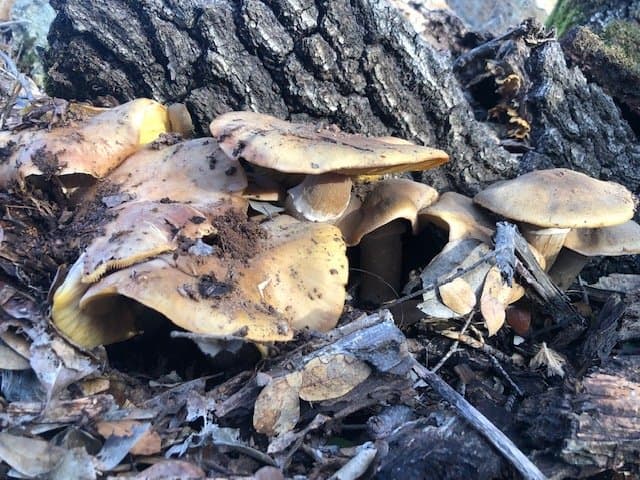
The three fungi I see most often on El Dorado County oaks are Armillaria mellea, Laetiporus gilbertsonii, and Omphalotus olivascens. Each one tells you something different about the tree. One is a root killer, one is a structural decay fungus, and one is mostly a recycler that happens to be poisonous. Telling them apart is the difference between an oak you can keep and an oak that has quietly become a hazard. I identify these in the field and under the microscope so the diagnosis is right before any decision is made. Independent consulting arborist, no removal crews, no stake in whether a tree comes down.
The oaks in question are the four that dominate this county: blue oak and interior live oak on the dry slopes, valley oak on the deeper soils, and California black oak through the middle elevations. All three fungi below can turn up on all four hosts, and Armillaria mellea does the most damage where the soil holds water longer.
1. Armillaria mellea, the oak root fungus
Armillaria mellea, often called honey fungus or oak root fungus, is a parasite of the roots and lower trunk and the most serious of the three. It causes a white rot that decays the wood and can kill the roots that anchor the tree. You usually notice it in fall, when clusters of honey colored mushrooms appear at the base of the oak, but the telltale signs are under the surface: flat white fans of mycelium beneath the bark and black, shoestring like rhizomorphs in the soil that let the fungus spread from root to root. Its mycelium is even faintly bioluminescent, the original foxfire. Armillaria is encouraged by stress and by summer irrigation against the root crown, which is exactly why lawns under native oaks are so damaging.
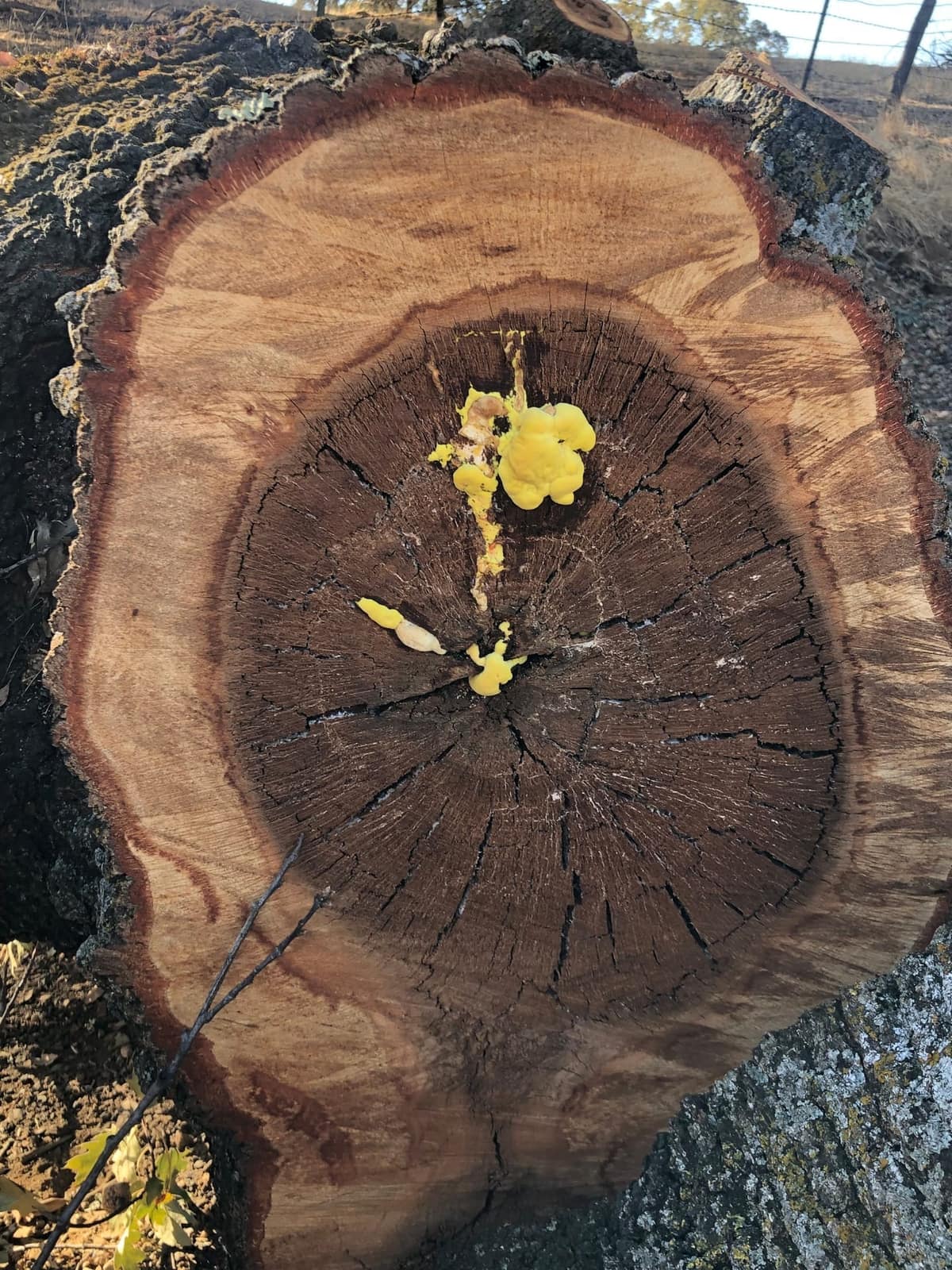
2. Laetiporus gilbertsonii, the California chicken of the woods
Laetiporus gilbertsonii is the bright orange and yellow shelf fungus that erupts from oak trunks and large limbs, the western, oak associated cousin of the chicken of the woods. It is beautiful and hard to miss, but on a structural tree it is a red flag. Laetiporus causes a brown cubical rot of the heartwood, breaking the wood into crumbly brown blocks and leaving it brittle, so a decayed trunk or limb can fail suddenly rather than bending first. An oak with Laetiporus fruiting from it often needs a tree risk assessment, because the decay inside can be far more advanced than the outside suggests. A note on eating it: the oak form is known to cause stomach upset in some people, so it is not the safe edible the eastern species is reputed to be.

3. Omphalotus olivascens, the western jack o lantern
Omphalotus olivascens, the western jack o lantern, fruits in dense clusters of olive tinted orange mushrooms at the base of oaks or straight from buried roots. It is the least threatening of the three to the living tree, working mostly as a saprotroph and weak parasite on dead and dying root and butt wood, so it often signals decay that is already present rather than causing the decline itself. It has two memorable traits: its gills glow a faint green in the dark, and it is poisonous. People regularly mistake it for the edible golden chanterelle and end up seriously ill, so it belongs in a notebook, never on a plate.
Why identification matters
Three mushrooms, three completely different meanings: a root killer, a structural decay fungus, and a toxic recycler. You cannot read the management from the mushroom alone, and lookalikes are common, which is why I confirm the organism by its features in the field and under the microscope before recommending anything. The same logic runs through all of my work: diagnose first, then decide.
Frequently Asked Questions
Does a mushroom at the base of my oak mean the tree is dying?
Not by itself. It depends on the species and on where it is fruiting. Armillaria at the base is a root pathogen and a real concern, Laetiporus signals structural decay in the wood, and Omphalotus means the wood at the base is already decaying, which on a multi stem oak is worth a closer look. The only way to know what you are dealing with is to identify the fungus and assess the tree, not to guess from the mushroom.
Are these oak mushrooms safe to eat?
Treat all three as off the table. Omphalotus olivascens is poisonous and is frequently confused with the edible chanterelle, and the oak form of Laetiporus causes stomach upset in some people. I identify fungi for the health and safety of the tree, not for the kitchen, and I never recommend eating a wild mushroom on the strength of a field guess.
Can you treat oak root fungus?
There is no reliable cure for Armillaria once it is established in the roots. Management is about reducing stress and slowing the fungus: keep irrigation and lawn off the root crown, improve drainage, avoid wounding the roots, and monitor the tree's stability. In some cases the honest answer is risk management rather than a save, which is exactly the kind of straight assessment an independent arborist can give you.
Sources
- Swiecki, T.J. and Bernhardt, E.A. 2006. A Field Guide to Insects and Diseases of California Oaks. General Technical Report PSW-GTR-197. USDA Forest Service, Pacific Southwest Research Station.
- UC Statewide Integrated Pest Management Program (UC Agriculture and Natural Resources), and standard California mycological references.