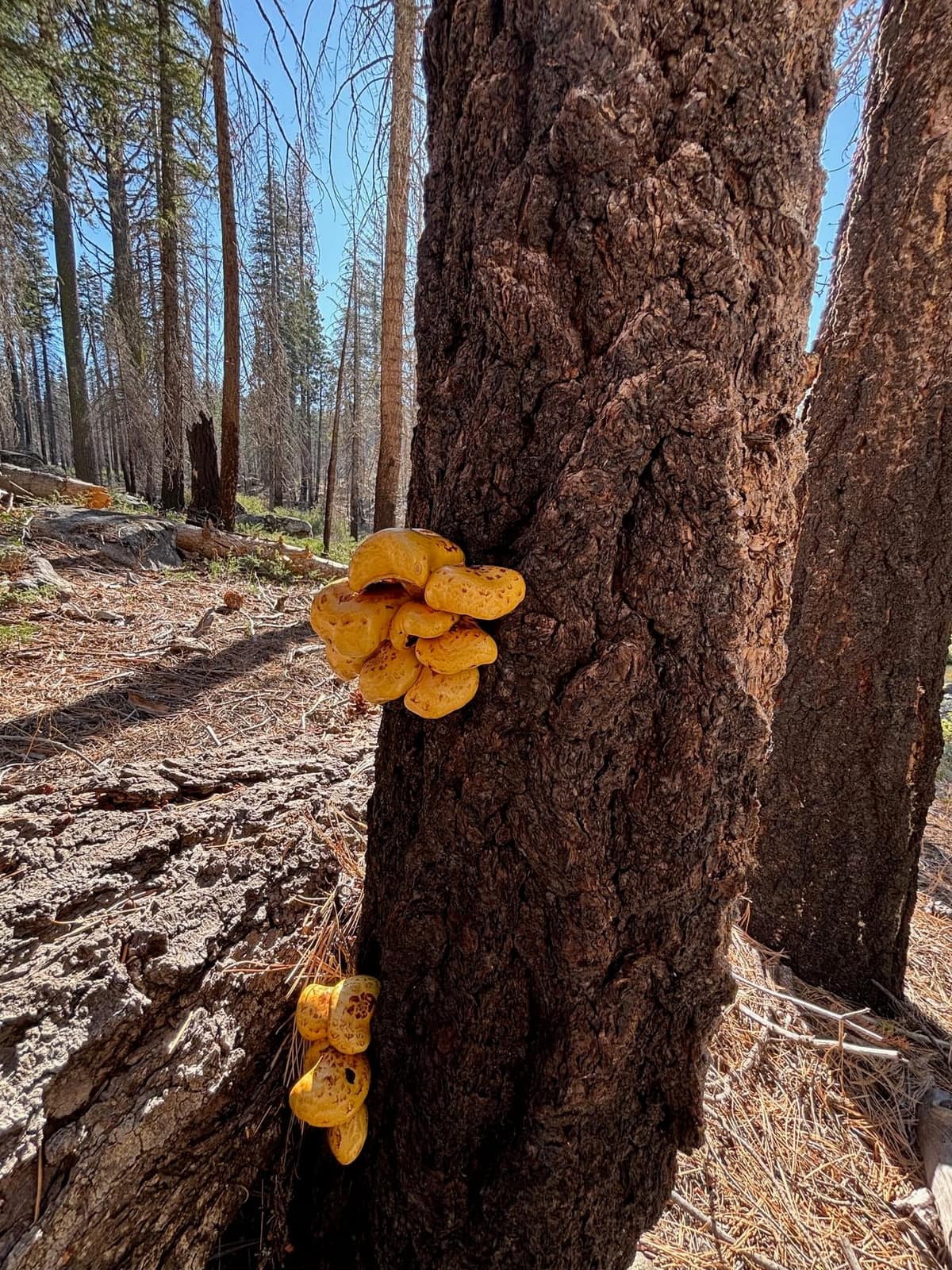
Mushrooms on a tree, or coming up around its base, are one of the most common reasons people call me in the fall. Most are harmless, and many are a good sign. A few are the first thing you can see of a decay fungus that has been working in the wood for years. The quickest way to find out which you have is to photograph the mushrooms before they collapse and text the photos to me at (530) 391-6100, or book a site visit.
Take four pictures: the top of the cap, the underside (gills, pores, or teeth), the base where it meets the wood or the soil, and a wider shot that shows where it sits on the tree. Note the date. Those photos and the location do more for an identification than any description.
What a mushroom on a tree is
A mushroom is the fruiting body of a fungus. The fungus itself is the mycelium, a network of fine threads living in the wood, the roots, or the soil, and it can live there for years without showing anything. When moisture and temperature are right, usually after the first fall rains here, the mycelium fruits, and the mushroom has one job, which is to release spores. So a mushroom tells you a fungus is present and has been for some time. It does not tell you what that fungus is doing until you know which one it is.
Every mushroom on or around a tree comes from one of three kinds of fungi:
- Mycorrhizal partners. These fungi live on the tree's fine roots and trade water and nutrients for sugars. Oaks, pines, and firs, most of what grows in the foothills, depend on them, and University of California IPM notes that many landscape trees, particularly oaks, pines, and other conifers, cannot grow or grow poorly without these partners. Their mushrooms come up from the soil under the canopy, often in fall, and they are good news.
- Decomposers. Saprotrophs break down wood and organic matter that is already dead: the roots of a tree removed years ago, a stump, construction lumber buried under a lawn, mulch, or dead branches. UC IPM lists buried wood and dead tree roots as the usual source of mushrooms in a lawn.
- Pathogens and decay fungi. These colonize living tissue in the roots, root collar, trunk, or main limbs, and decay the wood that holds the tree up. They are the minority, and they are the ones that matter.
Which group a mushroom belongs to, and where on the tree it is fruiting, decide whether it needs any attention at all.
Mushrooms at the base of a tree
The base of the tree is where location matters most. Three questions sort most cases:
- Is it attached to the tree? A mushroom growing out of the bark, the root flare, or a buttress root is coming from the tree's own wood. That points to a root or butt rot, and it is the location I take most seriously, because decay there weakens the roots and lower trunk that anchor the whole tree.
- Is it coming up from the soil, lawn, or mulch? Mushrooms a few feet out from the trunk, scattered under the canopy or in an arc or ring, are most often mycorrhizal partners, or decomposers working on mulch, buried wood, or old roots.
- Was a tree removed nearby? Mushrooms in a lawn where a tree once stood are usually feeding on its dead roots. With Armillaria that history matters, because the fungus can spread from infected roots and stumps to the roots of a living tree nearby.
Clusters of honey colored mushrooms at the root flare in fall are the case I am asked about most. That is often Armillaria, but California has six Armillaria species and only one of them, Armillaria mellea, is the aggressive oak root fungus. The others are weak pathogens at most. Telling them apart takes more than a photograph, and I go through it species by species on my Armillaria root rot page.
Reading the evidence after the mushroom is gone
Many mushrooms last only a few days. By the time someone notices a problem, or by the time I am standing at the tree, the fruiting bodies may be gone. The evidence usually is not.
Many fungal pathogens on trees produce ephemeral fruiting bodies, but leave signs that they were there. Here is what I look for on trees:
- Dried or decomposed fruiting bodies: identifying the species of fungi on a tree is important, and it takes decades of experience collecting, identifying, and observing fungi to know what they look like at every stage in life, even after the mushroom is well past its prime.
- Mushrooms on trees often leave behind spore prints on the bark, on moss living on the bark, or on spider webs in crevices or cavities. While spore color alone cannot definitively identify a mushroom species, it is a helpful diagnostic feature.
- Some species create cankers where they fruit, leave small patches of discolored bark, or leave other signs that a fruiting body appeared on that spot.
Being able to read the evidence of fungal presence can be crucial in helping understand how a tree should be managed.
It is also why a single visit in the wrong season can miss a fungus entirely, and why a record of what fruited on a tree, and when, is worth keeping. If you photographed mushrooms on your tree last fall, send those photos too.
Not every mushroom on a tree is a threat
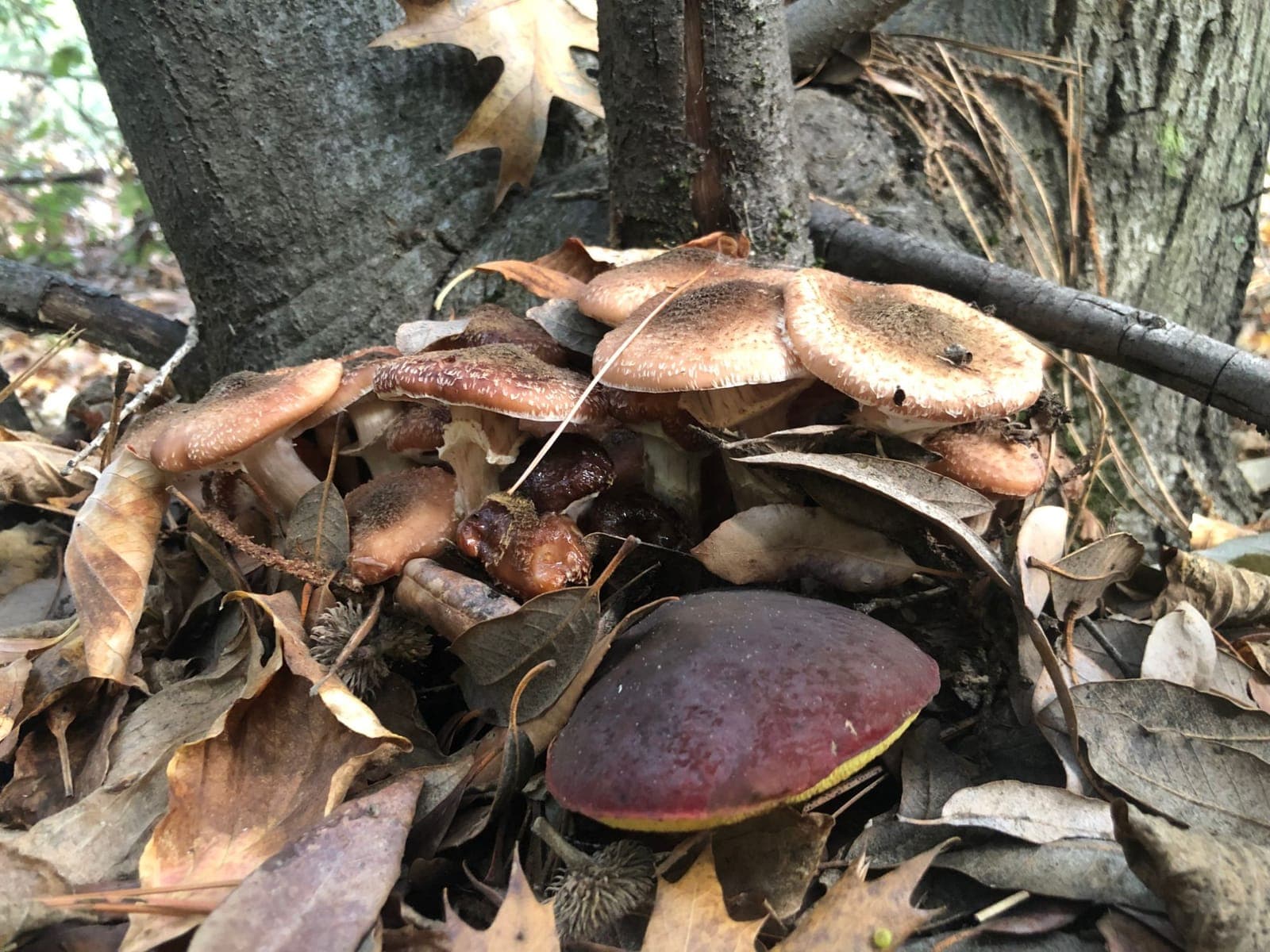
Additionally, many species of fungi pose no threat to trees. This photo of a Xerocomellus cluster with Armillaria sinapina is a great example. The Armillaria is fruiting from the tree as a weak pathogen, and the Xerocomellus is a mycorrhizal species that provides some benefit to the tree host. Even though some Armillaria species are aggressive pathogens, this one is not and only requires future monitoring. This illustrates why we cannot pursue better tree care with guesswork or generalizations. Every arborist needs to approach each tree as an opportunity to learn and grow their knowledge.
Should I remove the mushrooms?
You can, and it will not hurt the tree, but it will not help it either. The mushroom is only the fruiting body. The mycelium stays in the wood or the soil and fruits again the next time conditions allow, and UC IPM makes the same point about mushrooms in lawns: picking them does not kill the fungus that produced them. Photograph them first, because once they are gone the identification gets harder.
The good reason to remove them is safety. If children or dogs could eat them, pick them and bag them. Some mushrooms that fruit under trees in California are deadly, including the death cap, which grows with oaks, so never eat a mushroom from your yard on the strength of a photo match or an app.
When to have it looked at
I would have a tree checked when mushrooms or conks are growing from the trunk, the root flare, or the roots of a living tree, especially when that tree stands within reach of a house, a driveway, or a place people gather. The same goes for mushrooms together with any of these: a canopy thinning or dying back from the top, new cracks or a cavity, loose, cankered, or oozing bark near the base, soil heaving on one side, or a lean that has changed.
On a site visit I identify the fungus in the field where it can be named, and under the microscope where it cannot, and I look for the signs above when the mushrooms are gone. A site assessment with a written report starts at $500 and includes the identification, the evidence behind it, and a management plan. The site visit alone is $250 and covers up to one hour. I run no removal crew, so I have no stake in whether a tree comes down. Call or text (530) 391-6100.
University and mycological sources
- UC IPM Pest Notes: Mushrooms in LawnsWhere mushrooms in a yard come from (buried wood, dead roots, thatch), why picking them does not kill the fungus, and the mycorrhizal fungi that oaks, pines, and other conifers depend on.
- UC IPM Pest Notes: Wood Decay Fungi in Landscape TreesThe California reference on decay fungi in living trees and what their fruiting bodies indicate.
- UC IPM Pest Notes: Armillaria Root RotHow Armillaria spreads from infected roots and stumps, and how it is managed.
- MykoWeb, California Fungi: Armillaria sinapinaDescription of the weakly pathogenic Armillaria in the photo above.
- North American Mycological Association, mushroom poisoning syndromesWhy no wild mushroom should be eaten on a photo identification.
Frequently Asked Questions
Are mushrooms growing on my tree bad?
Not always. Mushrooms coming up from the soil under a tree are often mycorrhizal partners or decomposers, and both are normal. Mushrooms growing out of the living trunk, the root flare, or the roots usually mean a fungus is established in the wood, and that is worth having identified, because the species decides whether it is a weak pathogen to monitor or a decay fungus that affects the tree's structure.
What do mushrooms at the base of a tree mean?
It depends on whether they are attached to the tree. Mushrooms growing from the root flare or a buttress root point to a root or butt rot and deserve a closer look. Mushrooms a few feet out in the soil, lawn, or mulch are most often mycorrhizal fungi partnered with the roots, or decomposers feeding on buried wood or the roots of a tree removed years ago.
Why do mushrooms appear around my tree after rain?
The fungus is there all year as mycelium in the soil or wood. Rain and cooler temperatures trigger it to fruit, which is why the first fall rains bring a flush of mushrooms in the foothills. Mushrooms in summer usually follow irrigation, and UC IPM notes that overwatering and poor drainage encourage them.
Can an arborist tell what fungus it was after the mushrooms are gone?
Often, yes. Dried or decayed fruiting bodies, spore prints left on bark, moss, or spider webs, and cankers or discolored patches of bark where a fungus fruited all carry information. Reading them takes years of field experience with fungi at every stage, and where the field signs are not enough, a sample can be examined under the microscope or cultured.
Are the mushrooms under my oak tree poisonous?
Some may be. Oaks host many mushroom species, including the death cap, one of the most dangerous mushrooms in California. Treat every wild mushroom as unsafe to eat unless an experienced identifier has confirmed it in hand, and keep children and pets away from them. If someone does eat one, call Poison Control at 1 (800) 222 1222.
Will killing the mushrooms help my tree?
No. Picking, mowing, or spraying the mushrooms leaves the fungus in place, and no fungicide reaches a decay fungus inside the wood. Spraying the soil can also harm the mycorrhizal fungi the tree depends on. The useful step is identifying the fungus, then deciding whether the tree needs monitoring, care, or a closer structural assessment.