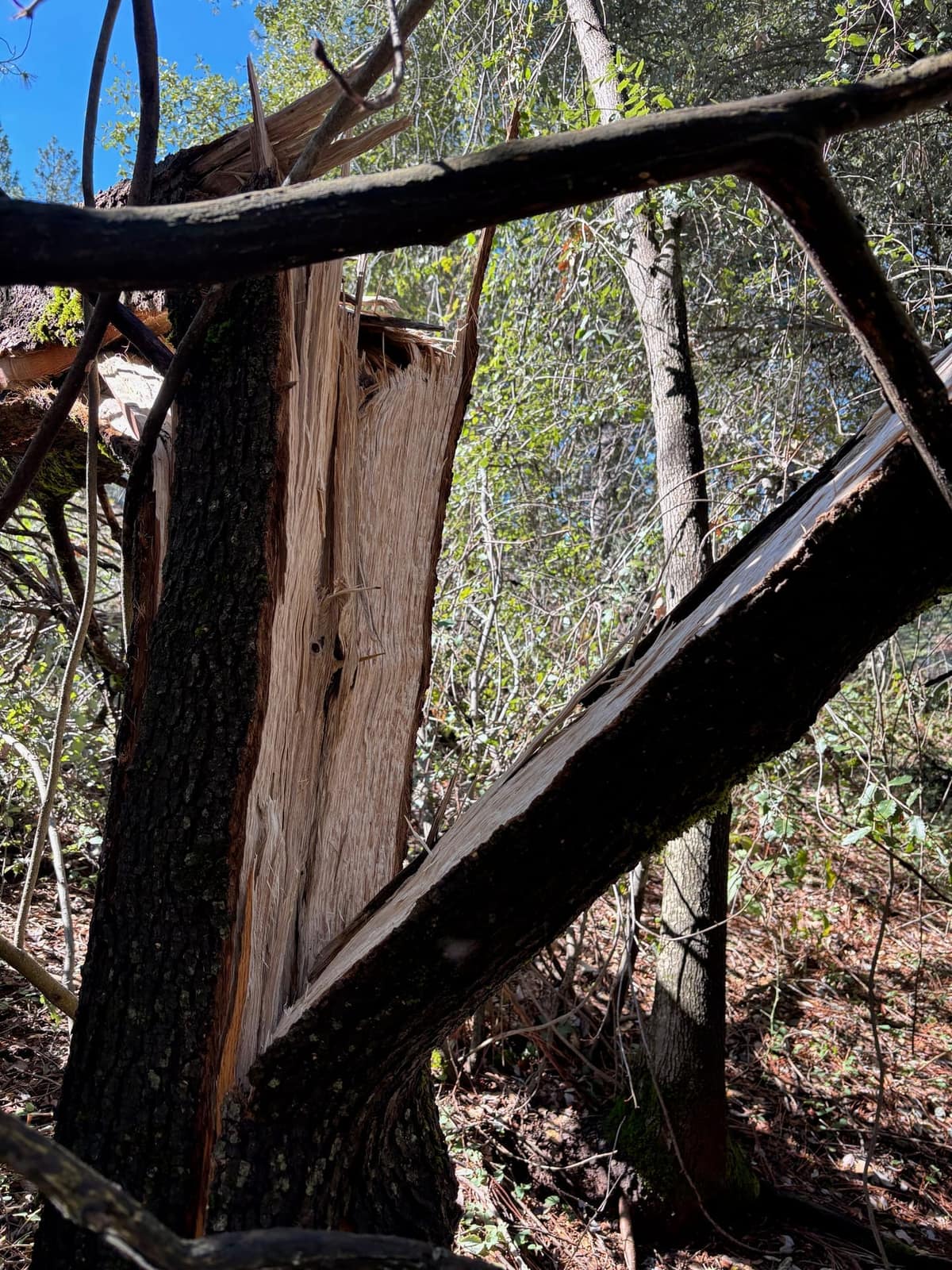
This year is shaping up to be the strongest El Niño on record, which could mean more intense storms producing atmospheric rivers that bring lots of precipitation and wind. Normal winter storms can lead to increased tree failures. Strong storms can cause huge numbers of tree failures. So let's break down some of the mechanisms of failure.
As of October 8, 2026, the NOAA Climate Prediction Center puts the chance of a historic event at 83 percent for October through December, which would be stronger than any El Niño since 1950. NOAA also says that the usual El Niño effects are more likely with a strong event but are not guaranteed.
1. Trees with risk features
Trees with risk features can't handle high winds or severe storms. When trees are compromised by wood decay fungi or other conditions that compromise structural integrity, they tend to be more prone to failure. Understanding how the location and type of decay impact a tree's structural integrity, as well as detecting hard to see decay pockets, can be critical for understanding a tree's risk of failure.
2. Saturated soil
Super saturated soil can make it difficult for any tree to use the soil as an anchor, especially those confined to small soil volumes by concrete. When soils get very saturated and high wind events follow, the Sacramento Valley sees high numbers of tree failures.
3. Heavy wet snow
In the mountains, heavy wet snow can overload trees and cause failures. A lower snow level can cause failures in the oak woodlands, as this area infrequently sees snow and our oaks frequently host internal decay.
4. Long limbs, thin trunks and weak unions
Trees with overleveraged limbs, trees whose trunks are facing heavy competition for light, so they have grown tall, small diameter trunks with poor taper, and trees with weakly attached limbs (older epicormic sprouts) or failure prone unions (codominant stems) are all more likely to fail when a storm loads them.
Warning signs you can see from the ground
- Conks or mushrooms on the trunk, at the base, or on the ground over the roots
- Cracks in the trunk or where a large limb joins it
- A lean that is new, or soil lifting and cracking on one side of the base
- Two trunks of about the same size joined in a tight V, with bark pinched between them
- Long heavy limbs with most of their foliage out at the ends
- Dead tops and large dead limbs over a house, a driveway or a place people sit
- Roots cut for a trench, a driveway or a patio in the last few years
None of these means a tree will fail. Each one is a reason to have it looked at before the storms and not after. If a tree or a limb is on a power line, stay away from it and call 911 and the utility.
Have your trees looked at before the storms
The best way to assess whether you need to take preventative measures is to have your trees looked at before the storms, so you are not surprised by a tree failure when there were warning signs an expert could have flagged.
A tree risk assessment with a written report starts at $500. The site visit on its own is $250 for up to one hour on site. I do no pruning and no removal, so I have no stake in whether a tree comes down. Call or text (530) 391-6100.
Book a tree risk assessmentSources
- NOAA Climate Prediction Center: ENSO Diagnostic DiscussionThe monthly forecast discussion. The figures above are from the discussion issued October 8, 2026. It is updated every month.