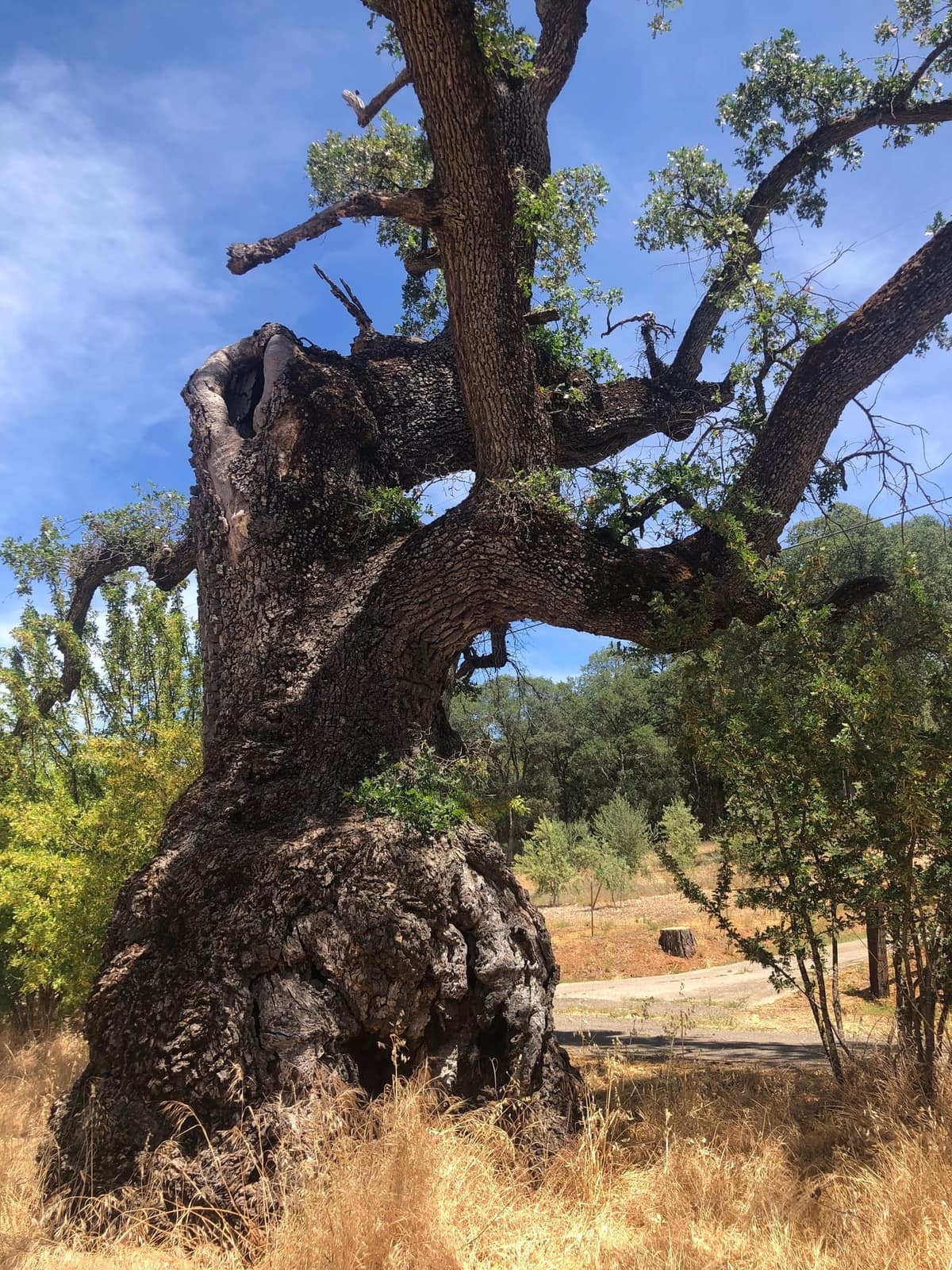
Oak tree care, done well, is mostly quiet work at ground level. I am Christopher Hodge, an ISA Board Certified Master Arborist, and I run a quarterly plant health care program for native oaks in the Sierra foothills and the Sacramento region. I come to your property four times a year, once in each season, to look after the roots and the soil and to catch problems while they are still small. It is care for trees you intend to keep.
The program starts with a site assessment and written report, from $500. That report is the baseline every later visit is measured against. Call or text (530) 391-6100 to get started.
Why oak tree health starts at the roots
A mature oak rarely dies from what you can see in the canopy. By the time the leaves thin or a limb dies back, the cause has usually been at work below ground for years: a root collar buried under soil or mulch, a sprinkler wetting the trunk all summer, a root zone packed hard by cars and foot traffic, or roots cut for a trench or a driveway. Our native oaks grew up with dry summers. Valley oak, blue oak, interior live oak, and California black oak all do their root growth on winter rain and expect the soil around the trunk to dry out in the heat. Most of the trouble I am called to starts when a yard changes that.
That is why this program is built on root care and prevention, and not on treatments. Keep the root collar clear and dry, keep air and biology in the soil, keep summer water where it belongs, and an oak will handle most of what comes at it on its own. How I do that depends on the tree and the site, and I work it out on the ground.
What a year of oak tree care looks like
Four visits, one in each season, because an oak asks for different things at different times of year.
- Winter. The tree is resting and the soil is wet. This is when I look hardest at the root collar and the base of the trunk, and when root and soil work does the most good.
- Spring. New leaves show how the tree came through winter. I read the growth, check for the pests and pathogens that arrive with warm weather, and compare the tree to its baseline.
- Summer. Heat and water decide a foothill oak's year. I check where irrigation is landing, how the soil is holding up, and whether the tree is showing drought stress.
- Fall. Before the rains I look at mulch, drainage, and anything that should be dealt with ahead of storm season, and I note what to watch next year.
After every visit you get a short written note: what I saw, what I did, and what has changed since the last one. Over a few years those notes become a record of the tree, which is worth having if you sell the property or need to show a county how the tree has been cared for.
Scheduled visits, not scheduled spraying
The visits are on a calendar. The treatments are not. I do not spray on a schedule, and this program does not include routine chemical applications. If a visit turns up a pest or disease that needs treating, I identify it first and then tell you what the options are. I hold a California Qualified Applicator License, so I can apply a material where one is warranted. I am not a Pest Control Adviser, and where a written recommendation is required I will tell you who needs to provide it.
Who the program is for
It suits a property with one or more mature oaks that matter: the heritage valley oak over the house, a stand of blue oaks on acreage, the trees a new home was designed around. It also suits oaks coming out of a hard stretch, such as construction nearby, a regrade, years of lawn irrigation, or a drought. If you want a single opinion on one tree, a one time assessment is the better fit, and I am glad to do that instead.
Oaks are where I do most of this work, but the same program covers the pines, cedars, and other trees on the property. The principle does not change: roots and soil first.
A disclosure, because I do the work I recommend
The root and soil work in this program is work I perform and am paid for: root collar excavation, root pruning, decompaction, and soil amendment. So when I tell you a tree needs it, I have an interest in the answer, and you should know that. Every finding goes in writing, and you are free to take it to anyone you like. I do no branch pruning and no removal, so I have no stake in whether a tree comes down.
What oak tree care costs
The first step is a site assessment with a written report, from $500. It covers the inspection, the condition of each tree, and what I would do about it. The quarterly program is then priced for your property, based on how many trees there are and what they need, and you see that price in writing before anything is scheduled. Root and soil work beyond the regular visits, laboratory identification, and any treatment are quoted separately.
Set that against the alternative. Removing a mature oak near a house commonly runs $1,500 to $4,000, it may need a county or city permit, and it is the one decision you cannot undo. A mature oak also cannot be replaced in your lifetime.
University and research sources
- UC IPM: OakThe University of California reference on the pests, diseases, and cultural problems of landscape oaks.
- California Oaks: Oak Tree CareCare guidance for native California oaks from the California Wildlife Foundation oak program.
- UC OaksUniversity of California research and guidance on oak woodlands and living with native oaks.
- Maintaining Oak Tree HealthGuidance on root zone protection, irrigation, and pruning timing for oaks near homes.
Frequently Asked Questions
How do I keep an oak tree healthy?
Leave the ground under it alone as much as you can. Keep the root collar visible and dry, keep sprinklers and lawn away from the trunk, do not add or remove soil under the canopy, keep cars and equipment off the root zone, and mulch with wood chips pulled back from the bark. Most of the oak decline I see traces back to one of those being ignored for years.
Should I water a native oak in summer?
An established native oak generally should not get regular summer water near the trunk. These trees are adapted to dry summers, and warm wet soil at the base favors root and crown diseases. Young oaks and oaks in a severe drought are different, and when water is needed it goes out near the edge of the canopy, deep and seldom. It is one of the first things I sort out on a site.
Should I fertilize my oak tree?
Usually not. A mature oak in native soil rarely needs fertilizer, and a stressed tree is seldom a hungry one. Pushing nitrogen into an oak that is short of air or water produces soft growth it cannot support. I look at the soil first and feed only when something is missing.
Do you do deep root fertilization?
Not as a routine service. Deep root fertilization is sold widely as a cure for a declining tree, and for most oaks the problem is compaction, a buried root collar, or water, none of which fertilizer fixes. Where the soil is compacted I open it up with compressed air, and where a soil test shows a real shortage I amend for it.
Is an arborist a tree doctor?
It is a fair description of this part of the job. People use tree doctor for an arborist who diagnoses and treats tree health problems. I am an ISA Board Certified Master Arborist, the top credential the International Society of Arboriculture awards, and diagnosis and plant health care are what I do. I do no branch pruning and no removal.
How much does a plant health care program cost?
It depends on the number of trees and what they need, so I price it per property. It starts with a site assessment and written report from $500, and you get the program price in writing before any visit is scheduled.
Can I have a single visit instead of the program?
Yes. A site assessment with a written report starts at $500, and a site visit on its own is $250 for up to one hour on site with no report. Many people start there and decide about the program once they have the report in hand.
How often should an oak tree be inspected?
Once a year is a reasonable minimum for a mature oak near a house, and again after a major storm, nearby construction, or a change in watering. Quarterly visits catch seasonal problems that a single annual visit misses, which is why the program is built that way.